Johdanto
Have you ever assessed the securing lines for your heavy fleet? Correctly identifying what is mooring rope saves a vessel from drifting away and facing disaster. We make industrial marine lines for extreme tidal movement. Find the critical documents, precise load calculations, and structural layouts needed to ensure complete operational safety for your fleet.
What Is Mooring Rope? An Industrial Manufacturing Overview!
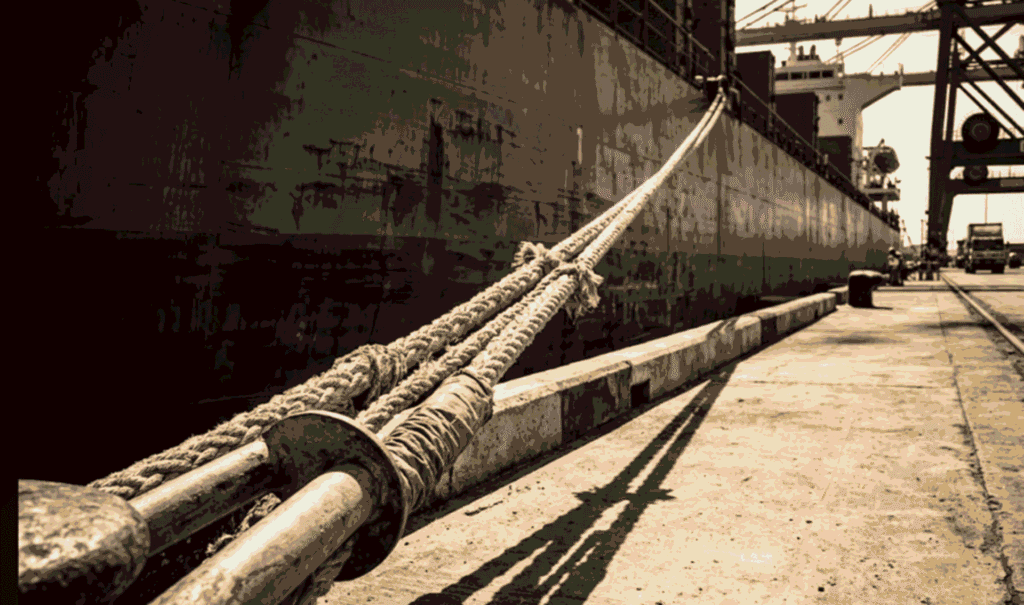
Thick mooring rope securing a massive cargo ship dockside.
Maritime operations require iron-clad infrastructure today. You can call what is a ship’s mooring rope called as laivojen kiinnitysköydet or heavy-duty hawsers on the floor. We design these tension-bearing cables to fasten large cargo vessels against piers and facilities. This acts as a protective measure in extreme weather conditions.
The Core Manufacturing Problem: High-Tension Failures
Synthetic fibers degrade in the harsh marine environment over time. The tensile strength value reduces rapidly in the tropical climate and the local high-salinity environment. Regular ropes typically break in hysteresis due to extreme tidal shifts. Is your current synthetic line compliant with the new OCIMF MEG4 Updates? You face expensive vessel drift and crippling port penalties without it.
I remember watching a massive hawser snap during a sudden squall in the Port of Singapore, and the sound was exactly like a cannon firing. Intel Market Research notes, ‘synthetic ropes significantly decrease the risk of dangerous recoil injury events.’
§ UV Radiation Degradation
Intense and prolonged sunlight destroys unprotected synthetic polymer chains at a molecular level during long journeys. This proves to be a critical failure over months of active commercial service. Continuous solar bombardment turns load-bearing fibers brittle and weak.
Extreme tidal shifts bring tension to these weakened lines against concrete piers. The hawser snaps with a violent kick without any clear visual warning signs beforehand.
§ Saltwater Crystallization Fraying
Sea water penetrates deeply into the woven jacket of conventional mooring lines during normal port operations. The tropical heat evaporates this trapped moisture, and microscopic salt crystals remain inside the core.
These ragged crystalline structures function like minute razor blades. They brutally slice through the internal filaments essential to life every time that rope stretches by extreme mechanical loads.
§ Dynamic Shock Overload
Surges of velocity and dissipating energy result in massive kinetic energy spikes. Unpredictable storm-driven waves and heavy merchant ships travel through the area and cause this.
These unexpected force variations easily exceed the defined safe working limits for normal marine equipment. This violent mechanical stress leads to instant hawser parting. It poses an immediate threat to deckhands and risks vessel drift in harbor environments.
§ Frictional Heat Accumulation
Heavy vibrating longitudinal friction against rusted steel fairleads and bollards produces high heat points. It creates extreme localized temperatures directly inside the protective rope jacket. The extreme physical rubbing instantly liquefies the synthetic core fibers beneath it.
This internal melting destroys the total structural integrity completely. Deck crews miss this melting during visual inspections, and they leave vessels secured with compromised lines.
The Technical Solution: Advanced Polymeric Engineering
We create ropes designed for use at these specific friction points. The upgrade to 12-Strand UHMWPE lines with UV coating is a measurable solution. You must eliminate vague modifiers such as very strong or highly durable from your vocabulary. You need to swap adjectives for raw and verifiable data.
Duracordix engineers understand this requirement perfectly and apply it to every design. As noted by the Oil Companies International Marine Forum (OCIMF), ‘Regular inspection and adherence to MEG4 guidelines are critical for preventing catastrophic mooring failures.’
§ Molecular Weight Optimization
Microscopic polymer chains optimally align along the primary load-bearing axis using ultra-high-molecular-weight polyethylene. This modern manufacturing technique delivers a colossal strength-to-weight ratio. It surpasses traditional steel wire cables by a wide margin.
This chemical formulation provides physical security with inherent positive buoyancy. It permits heavy work as commercial lines float safely away from spinning submerged vessel propellers.
§ Protective Polyurethane Coating
Specially formulated marine-grade chemical barriers completely prevent damaging saltwater intrusion into the primary core. The heavy industrial coating actively prevents harmful ultraviolet rays from damaging the synthetic polymers.
This protective layer enormously increases the secure functioning life of the hawser. It makes infallible operation certain even under extreme equatorial marine circumstances and weather.
§ Advanced Braiding Architecture
A highly engineered twelve-strand hollow braid design eradicates destructive core-to-cover friction during heavy mechanical loading. This geometric construction guarantees perfect relaxation of the structure along the entire line.
It ensures total structural stability for the rope. This open woven architecture enables trained deck crews to perform secure field splicing during emergencies. It restores full operational capability immediately for the crew.
§ Elastic Mooring Tails Integration
The prevention of mechanical shock is absolutely essential for maritime safety. Manufacturers achieve this by adding specially engineered nylon pennants to rigid primary lines.
This highly elastic hose section buffers the main synthetic hawser from kinetic spikes. Sudden squalls create these dangerous kinetic spikes. It keeps expensive deck machinery from catastrophic overload and maintains a cargo vessel safely against the pier.
Engineering Materials: What Is Mooring Rope Made Of?
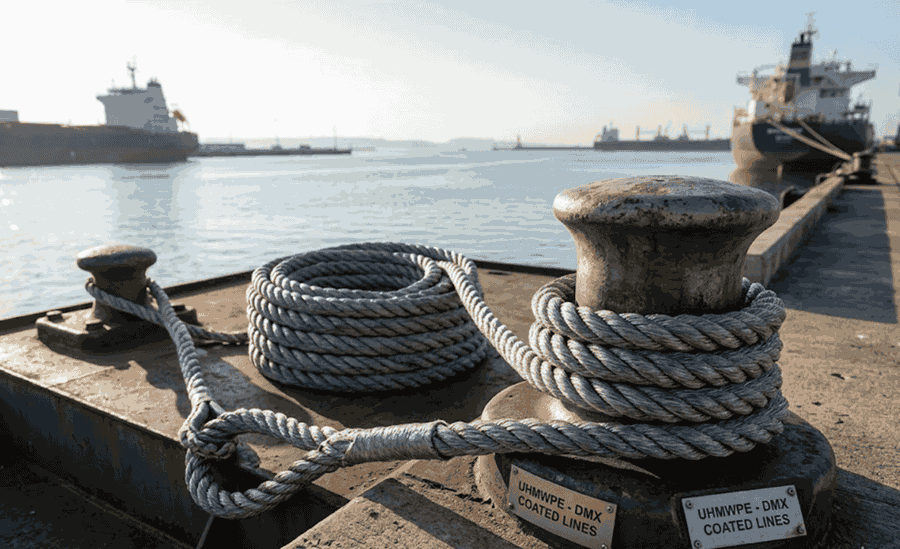
Coiled synthetic mooring rope resting on metal dock bollard.
Knowledge of what is mooring rope made of determines its use case, lifetime, and maintenance regimen. Manufacturers use several higher-level synthetic polymers depending on the required load metrics. Have you checked the material composition of your current dock lines lately?
Ultra-High-Molecular-Weight Polyethylene (UHMWPE)
UHMWPE represents the next level of modern synteettinen köysi manufacturing. We engineer UHMWPE-köysi and netting with our specialized DMX coating. This coating increases the water-resistant quality and makes them more durable in marine conditions. When we switched our primary fleet to UHMWPE lines last year, our deck crew reported a massive reduction in handling fatigue during long shifts.
- Specific Gravity: 0.97 (Floats on water).
- Melting Point: 144 °C to 152 °C.
- Elongation at Break: Very little stretch occurs under significant load.
- UV-kestävyys: It is very resistant to all chemical wash downs by default.
High-Tenacity Polyester (PET)
Polyester offers excellent structural integrity for heavy marine operations. Our DMX coating provides durability, added abrasion resistance, and peak performance. It helps throughout the high-friction docking process against gigantic concrete piers.
- Specific Gravity: 1.38 (Sinks in water).
- Melting Point: 260 °C.
- Elongation at Break: It provides moderate stretch for everyday gripping.
- Friction Resistance: It has excellent wet and dry abrasion resistance.
Polyamide (Nylon)
Nylon absorbs extremely large amounts of kinetic shock in the water. It is ideal at dynamic load conditions because of this property. We apply our DMX coating to these types of ropes to enhance performance. It improves durability, abrasion resistance, and salt degradation protection in service.
- Specific Gravity: 1.14 (Sinks in water).
- Melting Point: 215 °C to 220 °C.
- Elongation at Break: It has high tensile properties for wave shock absorption.
- Water Absorption: It loses some tensile strength upon wetting without surface treatment.
Polypropeeni (PP)
Polypropylene provides a lightweight and economical solution for marine vessels. It is ideal for inland waterway transport and similar tasks. These lightweight types of ropes feature our DMX coating. This coating greatly improves durability and abrasion resistance against sunlight.
- Specific Gravity: 0.91 (Easily floats over water).
- Melting Point: 165 °C to 170 °C.
- Elongation at Break: It has high elongations before the material fails.
- UV-kestävyys: It needs heavy inhibitors to avoid quick ultraviolet breakdown.
Aramid Fibers (Kevlar/Twaron)
Aramid fibers provide extreme heat resistance and zero creep with static loads. We top them with our DMX coating to strengthen the long ropes. This coating prevents internal friction inside these woven abrasive materials.
- Specific Gravity: 1.44 (Sinks quickly in water).
- Melting Point: Around 500 °C charring point.
- Elongation at Break: It will not stretch and has the limits of steel.
- Friction Resistance: It is prone to self-scrubbing without advanced core lubrication.
Mixed-Fiber Composites (Polypropylene & Polyester)
Composite blends benefit from the unique physical properties of various synthetic polymers. We finish these hybrid ropes with our DMX coating for extra protection. It builds in extreme durability, abrasion resistance, and increased performance during continuous loading.
- Specific Gravity: This varies with the exact material blend ratio.
- Melting Point: Composite materials have two distinct thermal extremes.
- Elongation at Break: It balances elasticity to handle an average dynamic shock.
- Friction Resistance: The polyester overcoat gives amazing external wear resistance.
| Polymer Material | Specific Gravity (g/cm³) | Thermal Limit (°C) | Murtovenymä (%) | Avg. Tenacity (N/tex) | Core Characteristics & Coating |
| UHMWPE | 0.97 | 144 – 152 | 3.0 – 4.0 | 2.5 – 4.0 | High UV Resistance / DMX Coated |
| High-Tenacity PET | 1.38 | 260 | 12.0 – 15.0 | 0.7 – 0.9 | High Friction Tolerance / DMX Coated |
| Polyamide (Nylon) | 1.14 | 215 – 220 | 15.0 – 28.0 | 0.7 – 0.85 | High Kinetic Shock / DMX Coated |
| Polypropeeni (PP) | 0.91 | 165 – 170 | 18.0 – 22.0 | 0.5 – 0.7 | Requires UV Inhibitors / DMX Coated |
| Aramid Fibers | 1.44 | 500 (Char) | 1.5 – 3.0 | 2.0 – 3.0 | Zero Creep / Core Lubricated DMX |
| PP/PET Composite | 0.99 – 1.10 | 165 & 260 | 14.0 – 18.0 | 0.6 – 0.8 | Balanced Elasticity / DMX Finished |
Marine Mooring Rope Polymer Specifications & Load Metrics!
Categorizing the Types of Mooring Ropes!
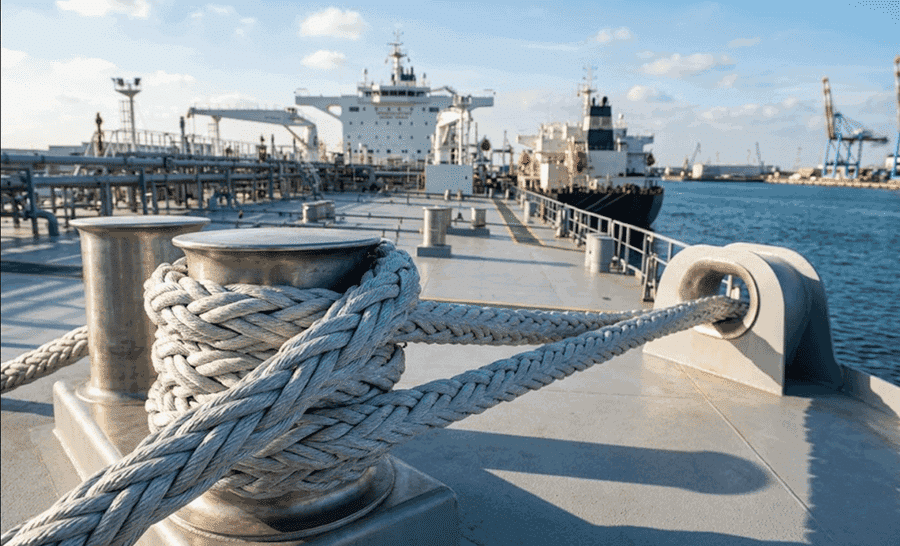
Heavy braided mooring line wrapped around ship deck bitt.
Vessel operators must choose the proper types of mooring ropes based on deadweight tonnage and infrastructure. A careful choice of stranding configuration and material composition averts catastrophic equipment failure. Modern engineering provides solutions to match any mooring lines arrangement on the deck.
12-Strand Braided UHMWPE Ropes
Supertankers today require mission-critical tensile strength without any compromise. They also need the look and feel of an extremely lightweight product. Our twelve-strand braided UHMWPE lines provide total safety for big boats. These factory-manufactured ropes utilize our proprietary DMX coating. This coating vastly improves durability, abrasion resistance, and marine performance.
Pros
- Weight Profile: It features high-water float for quick deployment.
- Tensile Strength: This is on par with steel cables of the same diameter.
Cons
- Temperature Limits: It can cross melting points with grinding.
- Kinetic Energy: It requires elastic tails for proper shock absorption.
Sovellukset
- Vessel Types: It provides safe mooring for ultra-large LNG carriers.
- Satamatoiminnot: It is the best choice for high-friction heavy mooring.
8-Strand Plaited Ropes
Eight-strand plaited ropes are the most common choice for general cargo vessels. Crews use them for standard dockside securing operations. This balanced manufacturing construction prevents structural torque and dangerous line rotation. We coat these ropes with our advanced DMX coating to increase durability.
Pros
- Handling Dynamics: It does not experience any torque during operation.
- Joustavuus: It bends easily in standard deck machinery.
Cons
- Splice Complexity: It requires highly specialized deckhand training.
- Core Exposure: It has no external protective structural jacket.
Sovellukset
- Vessel Types: It suits dry bulk and general cargo ships.
- Marine Logistics: It handles inland waterway barge lashing work.
Double Braided Synthetic Ropes
Specialized military vessels and contemporary cruise ships need core-dependent strength. They need this strength safeguarded under a solid external skin. Double braided ropes provide this exact dual-layer security. These cutting-edge ropes feature our proprietary DMX coating for extreme durability and dynamic performance. Have you inspected your double braided lines for internal wear recently?
Pros
- Structural Protection: An outer jacket protects the load-bearing core.
- Iskunvaimennus: It perfectly handles sudden spikes in kinetic energy.
Cons
- Internal Inspection: The core carcasses remain hidden from view.
- Water Retention: It absorbs moisture and increases operational weight.
Sovellukset
- Vessel Types: It fits military frigates and luxury cruise ships.
- Specific Tasks: It handles emergency towing operations for severe weather.
Steel Wire Ropes
Heavy-duty static holding requires an independent six-by-thirty-six galvanized wire rope core. Operators use these thick steel cables to immobilize massive rigs permanently. We treat the surrounding UHMWPE netting with our DMX coating. This treatment maximizes longevity, durability, and overall operational performance.
Pros
- Absolute Rigidity: It provides almost no elongation under substantial force.
- Crush Resistance: It withstands extreme mechanical winch compression forces.
Cons
- Operational Weight: It is very heavy and complicated to deploy.
- Corrosion Vulnerability: It rusts fast without permanent continuous lubrication.
Sovellukset
- Vessel Types: It secures giant offshore oil drilling platforms.
- Marine Infrastructure: It stabilizes permanent floating dock points.
3-Strand Twisted Ropes
Many smaller maritime operations rely on traditional three-strand twisted ropes. Crews use them for everyday utility securing tasks. This classic construction provides good elasticity and allows easy visual inspection. We use our niche DMX coating to bestow durability and abrasion resistance.
Pros
- Splicing Simplicity: It has the simplest rope structure for quick repair.
- Kinetic Stretch: It provides excellent wave shock absorption capabilities.
Cons
- Torque Generation: It has a strong tendency to twist and kink.
- Tensile Limits: It is not as strong as our complex braid designs.
Sovellukset
- Vessel Types: It works well for inland tugboats and fishing trawlers.
- General Deck Tasks: It secures turn-around equipment and tarps easily.
Load Metrics: What Is MBL in Mooring Ropes?
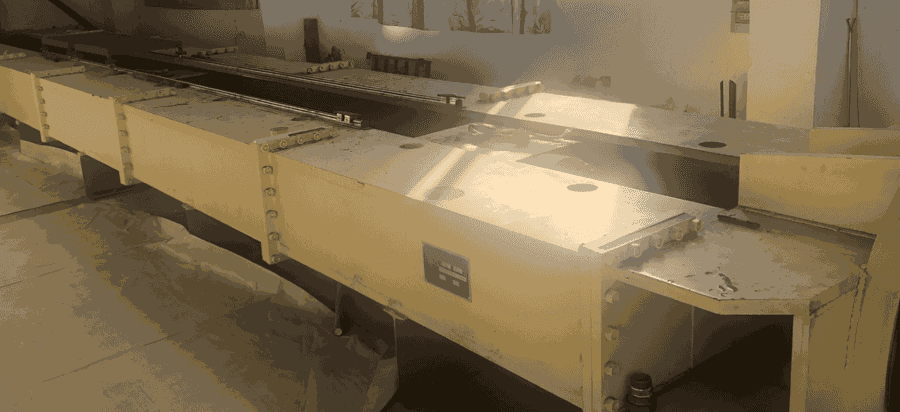
Industrial testing machine breaking a thick synthetic rope.
Safety always relies upon verifiable and unfiltered data during operations. Engineers need to know the definitive breaking point of their setup. Therefore, we must ask what is MBL in mooring ropes? Minimum breaking load represents the minimum force needed to break a completely new rope.
Standardized laboratory testing determines this exact limit using metric tons or kilonewtons. Have you ever witnessed a mooring line snap under extreme tension? Marine Public states, “Ship Design MBL provides the structural foundation for all vessel mooring systems.”
Calculating Line Design Break Force (LDBF)
Marine engineers never operate their vessels at the absolute maximum limit. Operators must find the functional and safe limits for everyday use. Consequently, people often wonder what is LDBF of mooring ropes? Line design break force indicates the exact limit when ropes receive splices and end terminations.
Splicing a rope naturally decreases its overall strength by approximately ten percent. These long deck box fillers provide the actual operational breaking limit for all your deck logs.
Safe Working Load (SWL) Ratios
- Synthetic Lines: Engineers usually calculate the safe working load to be twenty percent to twenty-five percent of the line design break force.
- Wire Ropes: The safe working load typically ranges between eighteen percent and twenty-two percent of the overall minimum breaking load.
- Hardware Terminals: Hardware must extend beyond the line design break force to prevent the deck from fracturing during a critical failure.
Mooring Lines Arrangement and Deck Setup!
The specific arrangement of your vessel’s lines determines how well it handles windage and tidal currents. This careful arrangement results in a highly effective tension geometric web. Are your current deck configurations truly optimized for severe weather?
Standard Deck Configurations
- Otsikko: These lines lead the vessel forward from the bow to discourage any unwanted knock back.
- Peräköydet: These lines extend rearward from the stern to actively inhibit any forward ship motion.
- Rintalinjat: These lines run vertical to the dock and pull the vessel very snug to the pier.
- Kevätlinjat: These specific lines run diagonally to help arrest any longitudinal surging alongside the dock.
Component Specifications: The Energy Absorber
High-modulus lines like UHMWPE lack the required stretch to absorb a sudden gust of heavy wind. This specific limitation brings a vital functional element into play immediately. What is mooring rope tail? A tail acts as a short piece of highly elastic synthetic rope attached directly to the main stiff rope.
It helps to absorb dynamic shock and prevents the main line from breaking due to sudden kinetic stress. Experienced deck officers often recount scenarios where an elastic tail saved their vessel during an unexpected and violent squall.
Selecting the Proper Mooring Rope Size!
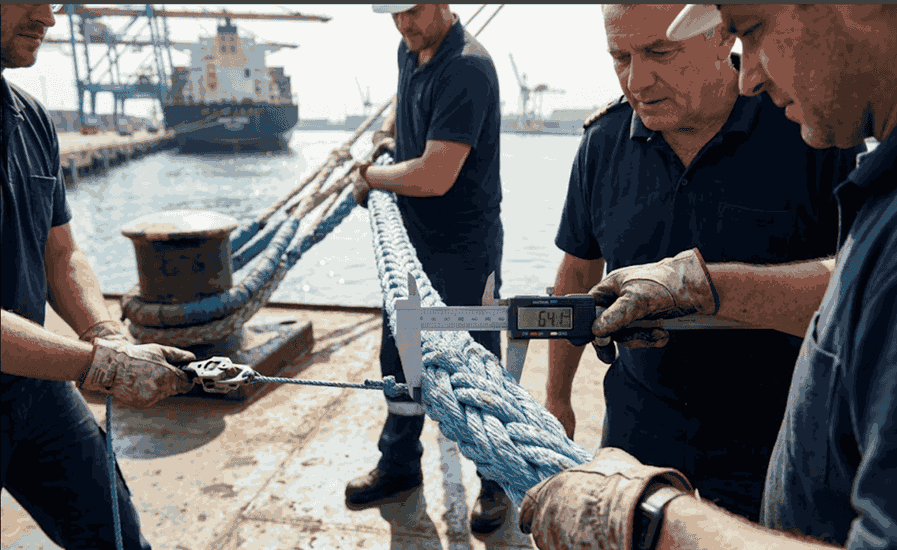
Marine workers measuring blue rope diameter with digital calipers.
The exact mooring rope size always stops catastrophic equipment failure from occurring. Naval architects size the equipment based on displacement and lateral windage area.
When a massive vessel meets a powerful gale, undersized lines can snap in mere seconds. Therefore, engineers must create extreme predictability for every single operation. Britannia P&I notes, ‘regular inspections of all mooring lines are essential for preventing accidents.’
Calculating Diameter And Cross-Section
Workers need to measure synthetic ropes just inside the broadest point of their cross-section under very light tension. Modern manufacturing universally utilizes the absolute diameter in millimeters because circumference measurements remain archaic. This exact millimeter measurement ensures that vessels maintain compliance with critical minimum safety parameters.
- Precise Measurement: Workers must apply two kilonewtons of pre-tensioning prior to taking the final diameter reading.
- Metric Transition: Operators should turn their legacy eight-inch circumference ropes into modern sixty-four-millimeter equivalents.
- Kantavuus: Engineers must cross-check their ninety-ton minimum breaking load against the precise diameter of the sixty-four-millimeter line.
Matching Fairlead And Deck Hardware
The diameter of the synthetic rope must perfectly match the ratio of your deck fairleads. An incorrect size creates horrible friction burns and melts right through the internal core. An upgrade requires a careful evaluation of the deck bitts to mitigate catastrophic structural deck failure.
- D-to-d Ratio: Operators must maintain a minimum ratio to ensure the longevity of their synthetic lines.
- Chock Specifications: Panama chocks should always maintain a minimum width of three hundred and sixty millimeters.
- Lämmönhukka: Kinetic friction heat spreads much more effectively over larger areas of hardware with bigger diameters.
| Component | Metric Standard | Legacy Equivalent | Load Specification |
| Synthetic Rope Diameter | 64 mm | 8-inch circumference | 90-ton MBL |
| Pre-Tensioning Force | 2 kN | Zero tension base | Diameter baseline |
| Your Fairlead Hardware | 15:1 D-to-d minimum | Sharp bend radius | Heat dissipation threshold |
| Panama Chock Width | 360 mm minimum | Standard deck bitts | Structural limit |
| Your Equipment Sizing | Displacement geometry | Lateral windage area | Extreme predictability baseline |
Mooring Rope Sizing And Hardware Specifications!
What Is the Best Rope for Mooring Lines?
Purchasing agents frequently ask what is the best rope for mooring lines? The perfect choice depends entirely upon your individual environment and your specific operational load. Virtue Marine suggests, ‘conventions set minimum standards for ship safety and environmental protection globally.’
Manufacturing Recommendations By Vessel Type
Very Large Crude Carriers (VLCC): These vessels require UHMWPE with polyester covers to withstand extreme static displacement effectively.
- Container Ships: These ships utilize a polypropylene and polyester composite for excellent buoyancy and a very good grip.
- Inland Barges: These barges use standard twisted polypropylene for lower costs and reliable shallow-draft services.
- LNG Carriers: These specific carriers use aramid lines because they offer incredible high-temperature resistance.
- Cruise Ships: These massive ships call out for double-braided nylon to ensure maximum shock absorption.
- Tugboats: These powerful boats rely on polyester lines that guarantee the maximum amount of fairlead durability.
- Bulk Carriers: These heavy carriers utilize blended polyolefins to withstand incredibly heavy dockside abrasion.
- Offshore Rigs: These stationary rigs depend on galvanized steel wire ropes for excellent static holding power.
- Naval Vessels: These military vessels use HMPE cables to achieve the maximum breaking load under heavy tension.
Maritime Terminology: What Is the Term in Securing a Mooring Rope?
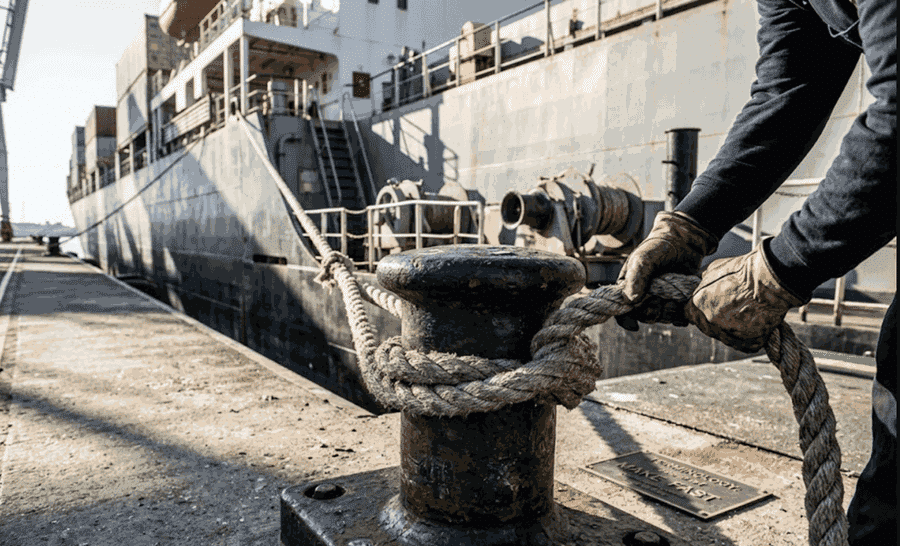
Gloved maritime worker securing heavy rope onto dockside bollard.
Effective communication onboard the vessel always avoids deadly mistakes during operations. Professional mariners use specific terminology to ensure that everyone understands the exact situation. What is the term in securing a mooring rope? Professionals use the phrase “make fast” to indicate the securing of a line.
Essential Deck Commands
- Make Fast: This command tells the crew to tie the line securely to a deck bitt or a dockside bollard.
- Let Go: This phrase instructs the deck workers to release the shore terminal line entirely.
- Heave Away: This order tells the crew to use the deck winch capstan to pull in the line safely.
- Slack Away: This command means to ease the line out slowly to reduce the immediate tension.
Johtopäätös
Selecting the proper materials remains highly critical when securing heavy marine vessels. Operating with reliable load-bearing lines ensures that everyone stays safer on deck. We hope this complete breakdown clarifies the core functions of marine lines and explains what is mooring rope well.
Our services align strictly with OCIMF standards. Contact Duracordix today for expert part manufacturing consulting and detailed technical specifications.
10 Frequently Asked Questions on Marine Ropes!
What Is Mooring Rope Used For Primarily?
Using these heavy-duty polymeric lines allows vessels to tie safely to docks or platforms. These strong lines counteract powerful winds and prevent dangerous drift caused by strong ocean currents.
How Do You Define What Is A Ship’s Mooring Rope Called?
The shipping industry typically calls them hawser lines, perpendicular breast lines, or longitudinal spring lines. The specific name depends solely upon their particular deck position and the orientation of the load vector.
What Are The Primary Types Of Mooring Ropes?
Manufacturers rigidly classify these lines into synthetic fiber ropes and conventional independent steel wire ropes. The specific core load configurations for these reliable lines remain highly specific and strictly defined.
Exactly What Is Mooring Rope Made Of?
Today, manufacturers construct reliable hawsers out of highly extruded synthetic polymers. Premium lines use ultra-high-molecular-weight polyethylene, while standard lines utilize a blend of high-tenacity polyester and polyamide fibers.
Why Is The Mooring Lines Arrangement Critical?
The standard six-point configuration geometrically scatters enormous kinetic energies away from the vessel. Perpendicular breast lines handle direct wind forces, while diagonal spring lines stop forward and backward surging.
How Do You Measure Mooring Rope Size?
All manufacturers obtain their absolute outer diameter measurement by lining up with precise millimeter markings. They perform this under a standardized reference tension load to ensure highly precise cross-section sizing.
What Is MBL In Mooring Ropes Testing?
The minimum breaking load represents the certified laboratory value measured accurately in kilonewtons. It shows the actual force required to rupture a new and dry line in accordance with standard conditions.
What Is LDBF Of Mooring Ropes In Operations?
The line design break force accounts for the strength reduction that mandatory splicing always incurs. It corresponds to the real and practical breaking threshold of the finished whole rope assembly.
What Is Mooring Rope Tail Designed To Do?
A certain level of elasticity remains essential, and a synthetic tail properly provides this necessary stretch. This section attached to stiff primary lines absorbs sudden dynamic shock loads from passing ships.
What Is The Best Rope For Mooring Lines Overall?
The strong UHMWPE line remains the time-tested industry standard for massive commercial ships worldwide. It offers incredible strength, extremely low weight, and excellent chemical and ultraviolet resistance.
What Is The Term In Securing A Mooring Rope?
Deck officers worldwide use the formal command “making fast” to issue a clear order. This command tells the deck crew to make a tensioned line as secure and tight as humanly possible.
 Suomi
Suomi  English
  Español
  Deutsch
  Français
  العربية
  한국어
한국어  Русский
  Ελληνικά
  Italiano
  Português
  日本語
日本語  Türkçe
  Tiếng Việt
  简体中文
简体中文  Svenska