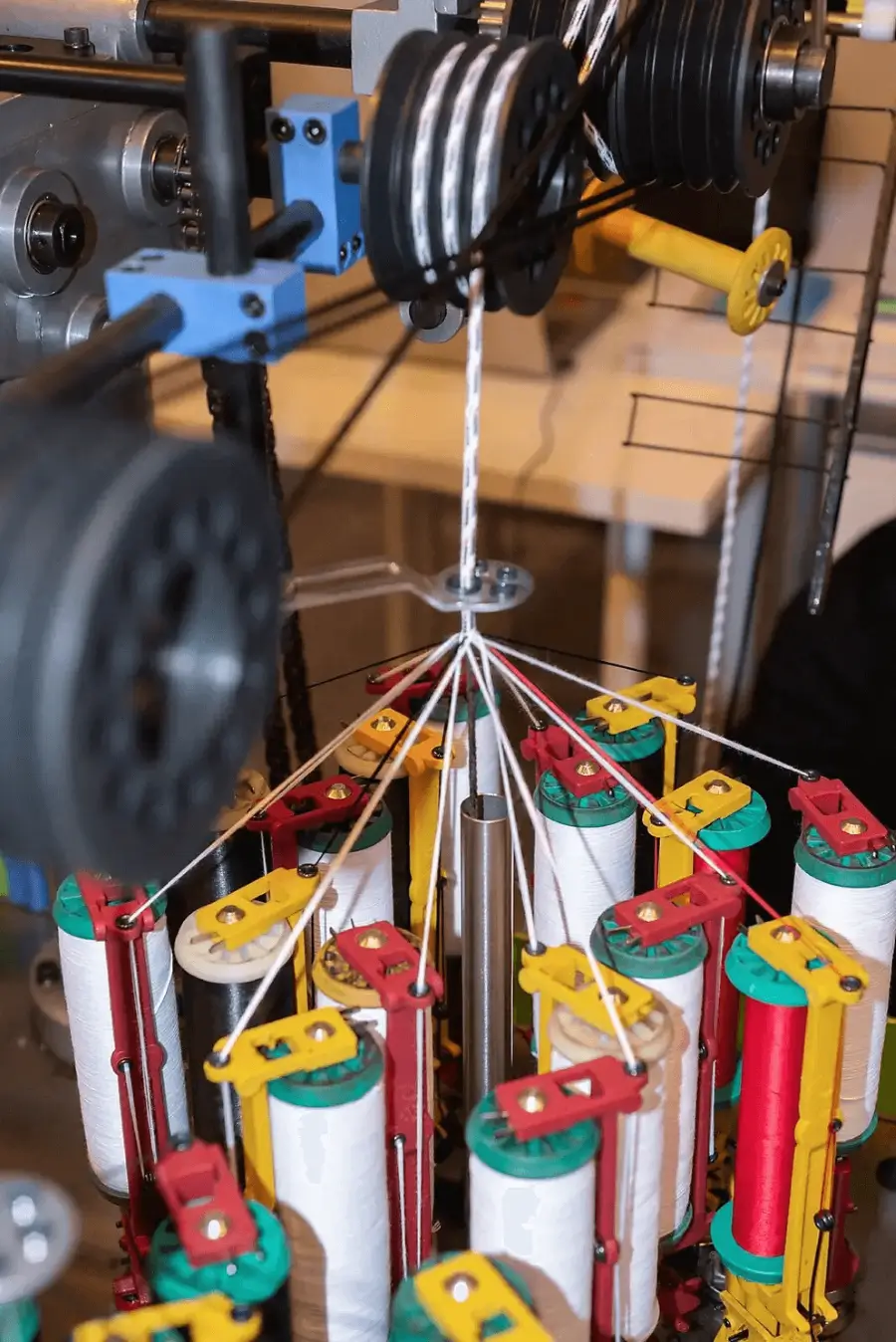
A mooring rope holds giant commercial ships to fixed locations such as docks or buoys for long periods of time. A dock line holds smaller recreational or commercial boats while crews secure them at marinas during active transport. Engineers design these robust systems for Minimum Breaking Loads well above 48 metric tons. The standard line breaks at a much lighter 5 tons for typical recreational marine craft.
導入
Lashing down vessels properly requires knowledge of technical differences. Studying mooring rope vs dock line specifications avoids total disasters under adverse sea conditions. The right materials will ensure longevity, and proper sizing has a direct impact on overall safety. We put together this guide so you can master marine securing systems and keep setups orderly.
The “Bottom Line Up Front”: Core Operational Distinctions!
Do you need to secure heavy tonnage at high salinity levels? The engineering differences between these two critical systems remain distinct, and you must understand them completely. あ 係留ロープ holds giant commercial ships to fixed locations such as docks or buoys for long periods of time.
A dock line holds smaller recreational or commercial boats while crews secure them at marinas during active transport. A wrong specification causes disastrous hardware failure during intense sea storms.
We explore the details here with Minimum Breaking Loads and elasticity of materials and UV degradation data. In my years on the docks, I have seen improper lines snap under pressure and cause severe damage.
Defining the Baseline: Mooring Rope Meaning and Function!
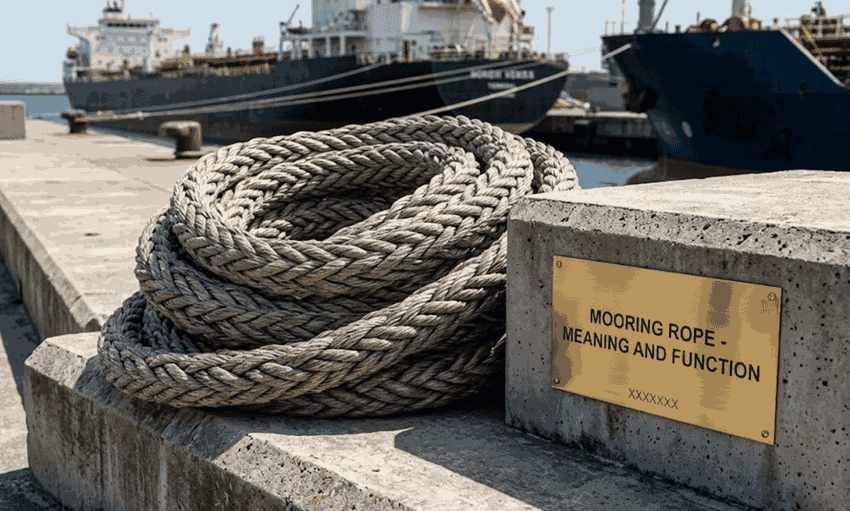
Coiled mooring rope on a concrete dock with brass plaque.
Marine safety requires pinpoint accuracy in your equipment specifics because the stress of high-tension applications destroys standard lines. If we explore the mooring rope meaning in the true sense, it represents heavy-duty hawsers designed for years of maintaining dynamic loads.
These heavy-duty ropes handle enormous kinetic forces for extended periods in hostile marine environments, and they regularly secure massive vessels under brutal atmospheric pressure. Are you still using outdated regulatory specifications for your active commercial fleet?
Primary Industrial Applications
Heavy-duty marine operations require a dedicated securing system designed to absorb enormous kinetic energy. Engineers deploy these high-modulus lines across perilous environments to retain massive vessels during severe weather events.
Commercial Cargo Securing
- The strong lines must hold huge bulk carriers in position through dynamic loading sequences.
- The durable material resists constant abrasion on rough concrete quays and steel mooring poles.
- Manufacturers design the lines to safely transport a massive Minimum Breaking Load across the ocean.
Offshore Rig Stabilization
- The secure system provides vertical wave action protection for deepwater drill rigs in rough waters.
- The setup uses coated synthetic lines for extreme saltwater resistance and long-lasting durability.
- The strong material maintains structural integrity under constant and heavy hydrostatic pressure without breaking.
Long-Term Port Storage
- The heavy system anchors safely decommissioned vessels during multi-year harbor lay-up periods.
- The strong line stops dangerous drift over high-traffic commercial navigation channels to prevent collisions.
- Operators must adhere to strict safety guidelines if they lay up vessels for extended periods.
Core Mechanical Properties
Modern hawser design employs advanced polymer science to prevent catastrophic and sudden failure on the water. Manufacturers design these lines according to certain breakout metrics and test them thoroughly. Under extreme tension, proper material selection eliminates dangerous incidents of sudden snap-back. According to Virtue Marine, recoil accidents result in severe or fatal injuries.
Tensile Strength Capacities
- The strong cord withstands heavy longitudinal stress without activating structural fiber plasticity or breaking.
- The advanced design disperses active loads over millions of microscopic synthetic filaments for safety.
- The material runs safely at the highest temperatures over nominal ambient temperatures without melting.
Environmental Resistance Factors
- The protective coating shields against continuous hours of intense and damaging ultraviolet radiation.
- The robust material resists all the aggressive chemical solvents found in industrial shipping terminals.
- The strong fibers withstand intense biological marine growth over prolonged periods of underwater operation.
Operational Failure Scenarios
Fatigue of equipment translates directly to catastrophic operational disasters on the busy boat deck. Crews must keep an eye out at all times for structural integrity issues so sudden partings do not occur. A mooring rope accident usually happens when crews ignore basic maintenance schedules and safety protocols.
High-Tension Mooring Failures
- The raw tensile strength deteriorates over a single year in extreme tropical humidity conditions.
- The friction melts the line locally when it slips across fast and heavy capstan drums.
- Internal salt crystal formation severs the core synthetic load-bearing yarns over an extended time.
Mitigation and Recovery
- Crews must use heavy-duty polyurethane chafe guards in the roughest contact points along the vessel.
- Operators must replace lines on a unit basis if they see severe localized glazing or melting.
- Crews must learn proper mooring rope splicing techniques to repair minor damages safely and efficiently.
Understanding Dock Line Mechanics!
Dock lines operate under an entirely different operational profile than heavy commercial hawsers. Mariners use dock lines to tie up temporarily, and they use them during daily maneuvers at temporary harbors. These dynamic systems must absorb the sudden spikes of kinetic energy caused by passing vessel wakes.
Stiff ropes give your deckhands trouble across active docking procedures and cause unwanted delays. I remember struggling with stiff ropes in freezing rain, and it taught me the value of pliable gear.
Core Dock Line Characteristics
Temporarily securing vessels on deck entails specific mechanical characteristics that prevent damage to deck hardware. Engineers develop these cords for maximum flexibility and swift deployment velocity and instantaneous kinetic energy absorption.
High Elasticity Requirements
- Kinetic Absorption: Nylon fibers stretch up when they face sudden boat wake shock loads.
- Tension Relief: The generous stretch allows deck cleats to dissipate violent ripping forces safely.
- Dynamic Load Mitigation: The stretchy lines spread tidal shift stress over several different deck fittings.
Handling Ease and Flexibility
- Manual Deployment: Crews need the ability to easily coil and throw their dock lines by hand.
- Cleat Hitching: Pliable filaments coil seamlessly around typical stainless steel deck cleats without slipping.
- Stowage Efficiency: Deckhands can fold them into a compact form for stowing in tight vessel lockers.
Environmental Vulnerabilities and Wear
Aspects of their operational lives remain brief, and this corresponds to constant physical wear. Saltwater saturation hastens the inner fiber destruction, and constant rubbing creates destructive heat pathology. Operators need to closely watch these weak points, or they face a sudden and disastrous failure.
Chafe and Friction Hazards
- Surface Abrasion: Repeated rubbing against wooden pilings wears the outer synthetic protection sheaths quickly.
- 擦れ防止: Crews use marine-grade leather sleeves over line sections that remain highly exposed.
- Heat Degradation: Rapid stretching and contracting generates destructive internal friction over an extended time.
Moisture and Chemical Exposure
- Salt Crystal Damage: Dried saltwater crystals cut through internal load-bearing synthetic filaments very quickly.
- Chemical Solvents: Harbor fuel spills readily solubilize untreated standard nylon polymer compounds in the water.
- UV Radiation: Direct sunlight cures fibers, and this creates high shrinkage and diminishes global tensile strength.
Sizing and Configuration Protocols
Tying down a vessel correctly requires exact measurements for length and precise calculations on diameter. Operators match the diameter directly to the specific boat displacement weight for ultimate safety. Undersized lines invite disaster, and oversized ropes refuse to stretch at regular tidal loads.
You should always consult a mooring rope size chart before making a final purchase for your vessel. PartsVu experts note, “Larger diameter lines resist wear and absorb more shock.”
Standard Dock Line Lengths
- Bow Lines: The length of the line must equal two-thirds of the total vessel length.
- 船尾線: The length of the stern line should remain the same as the bow line dimensions.
- 春のラインナップ: Crews use spring lines equal to the total overall length of the boat.
Diameter Specifications
- Light Craft: Boats under twenty feet require basic ten-millimeter diameter lines for adequate security.
- Medium Vessels: A forty-foot cruiser needs heavy-duty securing ropes with sixteen-millimeter thickness for safety.
- Heavy Yachts: Boats over sixty feet require massive braided lines for ultimate security and stability.
Deep Dive: Mooring Rope Material Specifications!
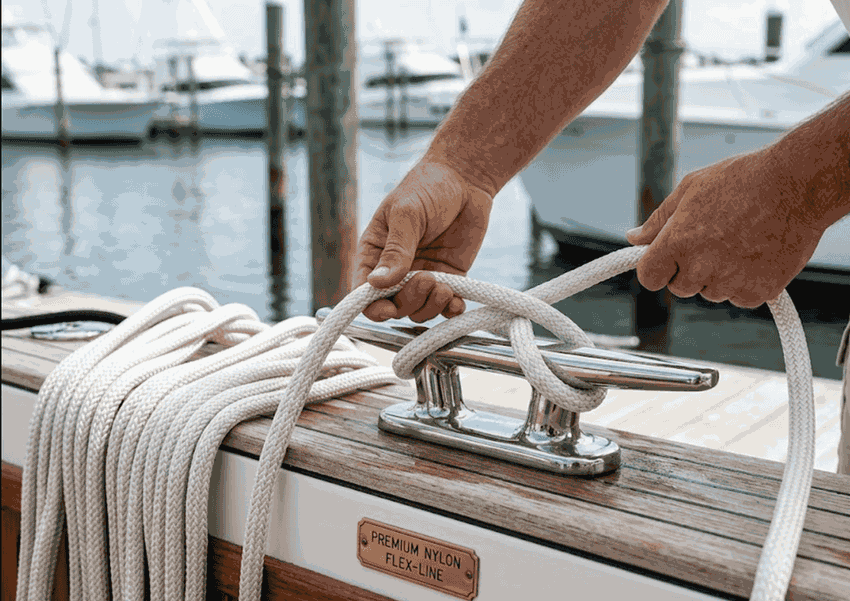
Person tying a white nylon dock line to boat cleat.
Choosing the right mooring rope material saves your boat during a storm. Modern builders choose high-yield synthetics. Neglecting material science leads to failure on the water. Chemical properties govern rope capabilities. Selecting the right polymer extends line life by 60%. These synthetic profiles help you buy the safest hardware.
Polyester (PET) Mooring Rope
Polyester is a workhorse for maritime securing. It retains full strength in water. This rope ensures accurate control in tight harbors.
長所
- The material endures radiation on the water.
- Synthetic fibers melt at 260 degrees Celsius.
- The compound maintains a density of 1.38.
短所
- The material weighs more than polypropylene lines.
- The heavy line sinks quickly. Recovery is difficult for crews.
What We Think Best
- The line works for permanent docks.
Optimal Deployment Scenarios
- Operators use it for long-term port lay-ups.
- Crews deploy it for heavy winch operations.
Nylon (Polyamide) Mooring Rope
Nylon acts as a shock absorber during storms. This rope stretches to absorb energy from waves. Strength reduces when saltwater saturation occurs.
長所
- The elastic line wicks forces without breaking hardware.
- Tough fibers provide abrasion resistance against concrete docks.
- The material operates within 220 degrees Celsius limits.
短所
- Strength reduces by ten percent when wet.
- Fibers shrink after soaking and drying cycles.
What We Think Best
- The stretchy line works for temporary berthing in waves.
Optimal Deployment Scenarios
- Crews use lines to handle high-tide surging.
- Operators use them for towing operations.
Polypropylene (PP) Mooring Rope
Polypropylene is a lightweight material for fast deployment. This rope degrades in sunlight. It remains inexpensive. Operators replace these floating lines periodically. This prevents structural failures.
長所
- The lightweight line floats on water.
- The material withstands corrosive chemicals in ports.
- The rope provides cost-efficiency for tight budgets.
短所
- The structure breaks down when exposed to radiation.
- Synthetic fibers melt at 170 degrees Celsius.
What We Think Best
- Crews use the floating material for rescue operations.
Optimal Deployment Scenarios
- Floating ropes mark boundaries in busy harbors.
- Operators deploy them as short-duration tow lines.
HMPE (Dyneema) Mooring Rope
High-Modulus Polyethylene represents advanced maritime engineering. This rope rivals the strength of steel wire. It has a tiny fraction of the weight. This material floats with ease. It takes on massive industrial loads.
長所
- Advanced fibers remain stronger than steel wire.
- The design provides a weight reduction of eighty percent.
- The material deflects chemicals and rays.
短所
- Fibers melt at 145 degrees Celsius.
- The rope needs a large capital investment.
What We Think Best
- The rope serves as the top option for commercial-haul work.
Optimal Deployment Scenarios
- Engineers use it for anchoring offshore oil rigs.
- Crews secure massive ships in high-wind facilities.
Aramid (Kevlar) Mooring Rope
Aramid fibers provide heat resistance and tensile strength. This rope withstands thermal environments without melting. Crews handle fabrics carefully to avoid fracturing fibers.
長所
- The line withstands temperatures up to 500 degrees Celsius.
- Fibers provide six times the strength of steel cables.
- The stiff material offers no stretch under tension.
短所
- Specialized fibers degrade during exposure to sunlight.
- Outer layers grow tattered from surface friction.
What We Think Best
- The heat-resistant line works for military designs.
Optimal Deployment Scenarios
- Crews deploy lines for shipping heavy industrial equipment.
- Operators use them for high-tension winching.
Liquid Crystal Polymer (LCP) Mooring Rope
Liquid Crystal Polymer possesses structural rigidity. It has no permanent creep under load. This synthetic offers stability in commercial ports. Engineers use it for precision and load control.
長所
- The stiff line cancels stretch during tensioning.
- The material survives temperatures of 330 degrees Celsius.
- Fibers provide abrasion resistance against steel cleats.
短所
- The core needs jacketing to stop radiation degradation.
- The material has a higher cost than nylon.
What We Think Best
- The stiff line works for light applications with technical requirements.
Optimal Deployment Scenarios
- Engineers use it for deepwater installs.
- Crews deploy it for high-load towing operations.
Polyethylene (PE) Mooring Rope
Standard polyethylene improves over polypropylene lines. It has protection against the sun. It retains floatiness for water operations. This synthetic excels in coastal fishing applications.
長所
- The floating line exhibits buoyancy for easy retrieval.
- The material handles abrasion better than polypropylene.
- Fibers offer durability across harsh saltwater conditions.
短所
- The line lacks extreme tensile strength.
- The material melts when temperatures reach 165 degrees Celsius.
What We Think Best
- The line works for commercial fishing operations.
Optimal Deployment Scenarios
- Crews use it for anchoring commercial trawl nets.
- Operators secure light fishing boats in the harbor.
PP/Polyester Composite Mooring Rope
Composite lines combine polyester durability with polypropylene fibers. This hybrid produces a cost-effective securing hawser. Operators enjoy weather resistance without the weight of pure polyester.
長所
- The ratio matches capacity with reduced weight.
- Outer polyester fibers act as a barrier against rays.
- The design maintains cost reductions compared to HMPE.
短所
- The stiff composite provides minimal shock absorption.
- Outer layers erode more quickly than nylon.
What We Think Best
- The hybrid rope remains the best compromise for reliability.
Optimal Deployment Scenarios
- Crews deploy lines for commercial berthing in sunlight.
- Operators use them for mid-weight cargo operations.
Mooring Rope vs Dock Line: The Technical Comparison!
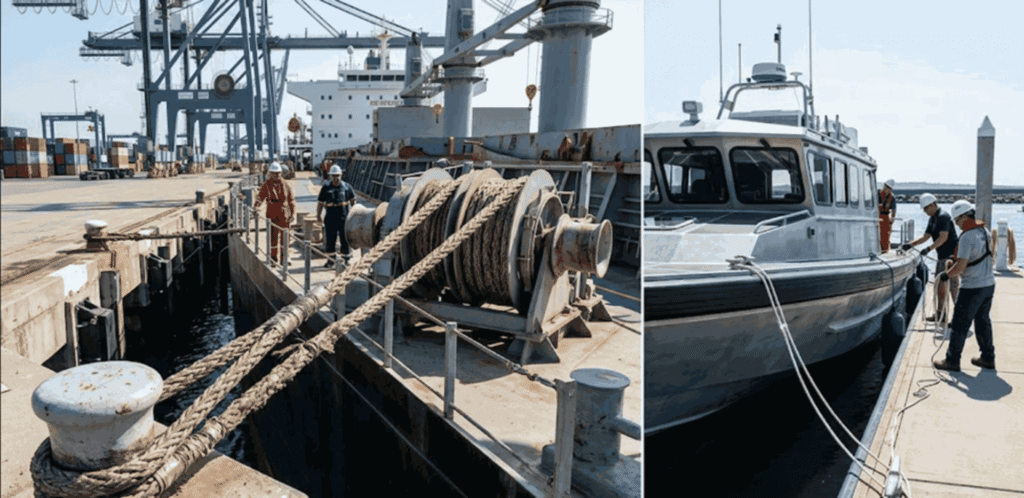
Cargo ship using heavy hawsers versus small boat dock lines.
Wherever you look, everyone calls it a dock line or a heavy hawser, so we must understand the technical comparison. Overworked marine engineers cannot afford any gray areas when they select heavy and secure marine hardware. We must understand the physical differences between heavy hawsers and light temporary lines to avoid catastrophic deck failures.
We break both of these marine systems down systematically across eight key technical engineering metrics below. During my early days on the commercial docks, I saw a snapped hawser tear right through a solid steel bulkhead, and I never forgot that terrifying sound. Do you truly know the operational limits of the synthetic lines securing your commercial fleet?
Primary Operational Applications and Deployment Duration
Vessel operators must determine specific operational deployment windows before they buy heavy securing lines. The mechanical load tolerances for temporary harbor transits differ greatly from multi-year deepwater anchorage setups. We will look into the precise kinetic demarcation between these vital maritime securing enablers.
Mooring Systems Operational Scope
- Commercial Freighters: The system extends lay-up periods for large 150,000-DWT vessels during their extended port-negotiated lay-ups.
- オフショアプラットフォーム: The heavy hardware secures deepwater oil rigs from the constant pounding of 15-meter wave action.
- Cargo Loading: The system changes position by millimeters during industrial sequences involving weights as heavy as 500 tons.
Dock Line Systems Operational Scope
- Marina Transits: This allows for quick five-minute securing tasks amidst active and busy municipal harbor transits.
- Manual Deployment: Deckhands provide point-based constant physical deployment through small 40-foot light commercial vessel credits.
- Fueling Stops: The line anchors sub-60-foot vessels at the shore during a typical two-hour harbor fueling process.
Regulatory Compliance Standards
- OCIMF Meg4: Marine operators must have mandatory compliance for extended deepwater deployment and securing operations. According to the Oil Companies International Marine Forum, “The Mooring Equipment Guidelines provide the standard for safe mooring operations.”
- OSHA 1918.106: Crews are required to conform with stringent industrial maritime workplace environments and safety standards.
- ABYC Standards: Marina lines must strictly adhere to the fundamental American Boat and Yacht Council safety guidelines.
Diameter Sizing and Minimum Breaking Load Metrics
The physics of your movement profile and your physical mass dictate absolute limits for absorbing kinetic energy. Engineers calculate the hawser diameter based on the actual vessel displacement tonnage and the expected windage drag. Sudden fatal snap-back events happen if you do not match the line diameter with the structural load.
Mooring Rope Dimensional Data
- Super Large Size Specification: Operators need sizes over 120 mm for the open type monitoring of huge 300-meter crude carrier ships. A standard 12 strand mooring rope provides immense strength for these massive commercial vessels.
- Breaking Loads: Engineers design these robust systems for Minimum Breaking Loads well above 48 metric tons.
- Winch Requirements: Crews need heavy 50-ton mechanical deck winches for standard safe tensioning and load control.
Dock Line Dimensional Data
- Nominal Diameters: The manufacturer displays nominal thicknesses that occur exclusively between 10 and 24 millimeters.
- Load Limits: The standard line breaks at a much lighter 5 tons for typical recreational marine craft.
- Capacity To Handle: Deckhands easily handle the launches without needing any heavy or complex mechanical machinery.
Critical Failure Modes
- Windage Ruptures: Under-dimensioned hawsers fail immediately under the tremendous drag forces of 400-kilonewton coastal storms.
- Hardware Tearing: Large marina lines will not give way, and they end up tearing stainless deck cleats out.
- Winch Slip: Mismatched rope diameters can slide freely against the massive 50-ton steel capstan winch drums. We use a strong mooring rope stopper to prevent this dangerous winch drum slippage.
Material Engineering and Polymer Composition Focus
Some synthetic fibers are extremely sensitive to extreme hydrostatic pressure because of their basic chemical composition. Manufacturers mix different polymers to create precise limits for thermal resistance and overall tensile strength. You must carefully match the molecular profile of your rope to the harsh marine environmental hazards.
Mooring Line Chemical Focus
- UHMWPE Cores: These use High-Modulus Polyethylene combined for unsurpassed strength-to-weight industrial load ratios. A premium dyneema mooring rope often features these exact advanced core materials for absolute safety.
- Steel Integration: The design incorporates heavy galvanized wire cores to maintain maximum structural rigidity under load.
- Polymer Blends: Engineers use 12-strand mixed polymers to balance floatation and survive harsh environmental abrasion resistance.
Dock Line Chemical Focus
- Marine Nylon: Manufacturers utilize high-quality nylon that provides 30 degrees of dynamic kinetic shock absorption.
- Treated Polyester: This application uses treated fibers that resist the breakdown caused by intense ultraviolet radiation over many months.
- Aramid Deterrence: The design prohibits stiff aramid core fibers, and this engenders the needed manual handling flexibility.
Thermal Degradation Thresholds
- UHMWPE Limits: Extreme 145-degree Celsius ambient atmospheric temperatures will cause heavy hawsers to melt in mere minutes.
- Heart Of Nylon: Solid marine nylon lines safely survive blistering ambient heat levels reaching 220 degrees Celsius.
- Winch Friction: Constant slippage creates localized 200-degree heat, and this extreme friction melts the synthetic protective jackets.
Elasticity Metrics and Kinetic Shock Absorption
We control the transfer of large kinetic energy amounts to prevent damaging stresses on the welded deck cleats. Some operations require hard and stiff lines for the precise positioning of the heavy commercial cargo.
Other applications need huge stretchability to survive violent tidal swells during the extreme coastal storm events. As Maritime Safety Publications notes, “Kinetic energy transfer must be strictly managed to prevent catastrophic hardware shearing during coastal storm surges.”
Mooring System Stretch Dynamics
- Highest Elongation: The material preserves a low stretch profile to limit the dangerous drift of 100,000-ton commercial ships.
- Collision Avoidance: The stiffness prevents dangerous hull strikes against concrete quays while crews moor the vessel for precise loading.
- Energy Transfer: The system slowly transfers the heavy kinetic energy across the entire 12-point commercial securing spread.
Dock Line System Stretch Dynamics
- Extreme Stretch: The lines absorb sudden kinetic shocks, like massive 40-knot boat wakes, very efficiently. A flexible bungee mooring rope works similarly for smaller boats in turbulent waters.
- Hardware Protection: A significantly protective and light setup prevents tearing up 12-inch deck hardware during severe motion.
- Torque: The fiber contracts smoothly without causing dangerous 50-mph line snap back at shifting positions.
Structural Fatigue Realities
- Rigid Industrial Lines: These stiff lines transfer the kinetic shock directly into the internal hull structures.
- Rebound Loss: The elastic fibers can only withstand around 1000 heavy tension cycles before they degrade.
- Internal Friction: The nylon load-bearing core filaments degrade at an alarming rate each time they are stretched.
Splicing Complexity and Hardware Integration
Ropes primarily rupture at their end fixtures when they are placed under significant industrial loads. Crews make these secure eye loops by precisely manipulating the microscopic synthetic fibers by hand.
Hawsers require complex hydraulic equipment to splice reliably, while temporary lines can be spliced quickly without complex tying. I remember splicing a heavy commercial hawser in freezing rain, and the stiffness made the manual manipulation nearly impossible without hydraulic assistance.
Mooring Rope Termination Requirements
- Hydraulic Machinery: Operators require bulky machinery to perform correct 12-strand eye splices in commercial maritime use.
- Engineer Validation: Companies need certified engineers to validate the integrity of the 48-ton load-bearing termination points.
- Steel Thimbles: The setup includes complicated hardware integration using huge 50-millimeter galvanized protective steel thimbles.
Dock Line Termination Requirements
- Manual Splicing: Basic operational deck crews can perform simple three-strand manual splicing quite easily.
- Cleat Compatibility: The line easily integrates with standard 12-inch stainless steel or basic nylon deck cleats.
- Emergency Knots: It fully works with basic bowline knots throughout a fast 3-minute emergency securing process.
Connection Point Vulnerabilities
- Knot Failure: Tying knots poorly can reduce the overall strength of that specific section of line by half.
- Corrosion Shearing: Rusty steel thimbles eventually cut into the internal synthetic core fibers and destroy them.
- Splice Unraveling: Ill-made splices unravel as soon as a harrowing 500-kilonewton tensioning load is applied to them.
Abrasion Resistance and Environmental Degradation
Continuous surface friction crushes the synthetic load-bearing fibers during their normal operational lifespans. Heavy maritime infrastructure consists of rough concrete walls and highly rusted steel securing bollards.
You need to rigorously assess how your structural profile deforms from physical wear and aggressive chemical solvents. According to Braidlace, ultraviolet radiation degrades polymer chains and reduces tensile strength.
Mooring Hawser Environmental Defenses
- 紫外線耐性: We test the ultraviolet resistance aggressively against 1,000 hours of continuous direct sun exposure.
- Crush Defenses: The material overcomes enormous structural crushing strength on motorized 50-ton steel winches.
- Chemical Resistance: It stands up firmly to rapid structural deterioration from heavy harbor fuel spill contamination. Using a durable mooring rope chafe guard provides another layer of critical physical defense.
Dock Line Environmental Defenses
- 擦れ防止ガード: We use aftermarket leather sleeves to prevent contact with rough wooden harbor pilings.
- Saltwater Compromise: The rope experiences rapid internal fabric breakdown due to the crystallization of dry saltwater crystals.
- Fresh Water Rinsing: The crew needs regular rinsing to sustain the best 16 mm flexibility and tensile strength.
Severe Weather Protocols
- Tropical Humidity: This severe weather gradually reduces the raw synthetic tensile strength over 12 consecutive months.
- Soggy Nylon: Freezing temperatures turn your saturated nylon lines into brittle and hard-to-manage deck hazards.
- High Salinity: The salt speeds up the microscopic abrasive physical damage of the internal load-bearing core.
Financial Investment and Procurement Lifespan
Balancing upfront capital expenditure with long-term operational durability is a patient craft for procurement managers. Inexpensive hardware leads to inevitable frequent replacements and dangerous deck failures in a highly hazardous manner.
By auditing the life cycle costs of your securing lines, operations become safer and more efficient. Are you willing to risk a 48-ton deck failure just to save a few dollars on initial procurement?
Mooring System Lifecycle Costs
- Capital Investment: Buyers face a significant initial outlay for premium 12-strand UHMWPE synthetic core materials.
- Roi Durability: The heavy system provides a tremendous return with a minimum 5-year commercial operational deployment lifetime.
- Avoidance Of Failure: Premium quality eliminates the massive 48-ton deck failure costs related to cheap hawsers.
Dock Line Lifecycle Costs
- Affordable Upfront: This system offers very low initial procurement costs for regular recreational maritime users.
- Seasonal Replacement: Frequent 12-month seasonal replacements are needed because of the quick environmental deterioration.
- Lifecycle Value: The line creates a lower overall 5-year lifecycle value than heavy industrial synthetic setups.
Procurement Logistics and Tracking
- Digital Tracking: Factories should digitally track the exact manufacturing dates for all heavy commercial hawsers.
- Procurement Logs: Engineers are strictly required to maintain logs that verify the Line Design Break Forces.
- Marina Lines: We strictly consider these light ropes to be completely disposable consumables without inventory tracking.
Dynamic Load Distribution and Deck Hardware
Maximum structural stress distribution averts the total ripping apart of the welded deck gear. Engineers figure precise breaking load ratios between the synthetic fibers and the stainless deck cleats. Heavy hardware gets torn directly from the hull if we cannot counterbalance these conflicting kinetic forces.
Mooring Rope Load Dynamics
- Kinetic Transfer: The system delivered intense 400-kilonewton kinetic energy over multiple pads on the deck bollard.
- Continuous Tension: Crews use motorized 50-ton capstans to tone heavy and continuous cargo tensioning loads. They attach a flexible 係留テールロープ to help absorb extra energy at the end.
- Static Friction: Heavy operations depend on 15-ton mechanical line stoppers to manage the dangerous static friction.
Dock Line Load Dynamics
- Shock Isolation: The material directly absorbs dynamic 5-ton kinetic shock loads to the single stainless cleats.
- Wake Absorption: Rapid internal fiber elongation cycles successfully absorb violent 40-knot harbor boat wakes.
- High Manual Tension: The light line enables easy manual tension settings without resorting to cumbersome 50-ton aides.
Deck Hardware Failure Zones
- Bollard Shearing: Massive 30-inch steel bollards can shear cleanly from decks when the load angles are incorrect.
- Helix: Undersized stainless steel fasteners pull out easily under large tidal surges of three meters.
- Fairlead Friction: Massive localized friction destroys outer protective jackets when the steel fairleads are not aligned properly.
Establishing a Mooring Rope Inspection Checklist!
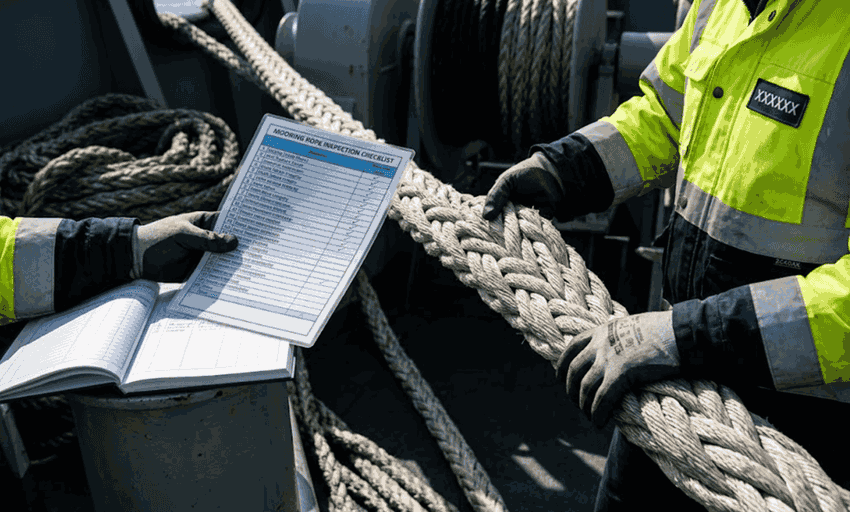
Workers inspecting thick braided mooring rope using a printed checklist.
Ropes do not fail suddenly; operators simply fail to heed the telling mechanical warning signs. You need to operate with a strict mooring rope inspection checklist and a periodic maintenance program. Are your deckhands missing microscopic fiber fractures during their routine 12-hour ship handovers?
Ignored localized 200-degree heat glazing causes catastrophic 48-ton deck failures during severe Category 4 storms. Visual guesswork causes those terrifying 400-kilonewton snap-back deaths on commercial shipping vessels.
Operators must enforce strict technical diagnostic logs for all commercial heavy hawsers. Proper preventative maintenance detects fatal flaws well before the load reaches the Line Design Break Force. Consistent mooring rope maintenance is the only way to save lives on the working deck.
Daily and Monthly Inspection Protocols
Crews must perform 12-hour commercial cargo loading visual diagnostics to ensure absolute safety. Mandating comprehensive physical examinations every 30 days helps engineers detect internal fiber degradation. We pay special attention to compliance and provide strict documentation to prevent lethal 50-ton winch accidents.
Daily Diagnostic Procedures
- Inspect for Glazing: Look closely for fused fibers, as they show evidence of serious 200-degree heat damage.
- Yarn Rupture Identification: You must number the ruptured load-bearing strands within a one-meter length of fabric.
- Assess Diameter Contraction: A localized thinning of 10 millimeters suggests severe core damage or internal overstress.
- Confirm Chafe Sleeves: Check the polyurethane sleeves over the rough 30-inch concrete quay points for tears.
Monthly Engineering Diagnostics
- Highly Accurate Operational Hours: Record the exact tension times on the motorized 50-ton steel winches.
- Inspect Splice Integrity: Look carefully for internal saltwater buildup crystals within the 12-strand eye splice.
- Check Hardness: Squeeze the thick 120-millimeter hawser tightly to feel for hard and bad spots.
- Document Chemical Exposure: Clearly note any accidental contact with harmful industrial harbor fuel spills.
Evaluate Mooring Rope Replacement Criteria
Actively extending the use of tainted synthetic lines obliterates your holistic operational safety thresholds. Prioritizing physical damage criticality against factory baseline metrics helps you qualify exact retirement schedules.
You must remove contaminated 12-strand hawsers from service before environmental breakdown causes total failure. Following strict mooring rope replacement criteria ensures your crew never operates with compromised safety equipment.
Mandatory Retirement Triggers
- Volume Loss Limits: Evict and replace lines with a one-tenth localized volume loss immediately.
- Severe External Strand Cuts: Cut and discard ropes that have three consecutive load-bearing external strand severing marks.
- Chemical Contamination: Get rid of the lines that are soaked with highly acidic industrial chemical solvents.
- Thermal Fusion Damage: Change the lines where extensive melted glazing spans across three bracing spans.
Troubleshooting Scenario: Heat Friction Management
Blistering heat is created when a 120-millimeter line slides across a 50-ton steel capstan. This thermal spike releases enough heat to totally melt the outer jacket of the UHMWPE. You need to shut down the motorized winch supporting the structure to avoid a collapse.
Immediate Corrective Actions
- Stop Winch Operations: The crew stops the massive 50-ton hydraulic drum rotation immediately. The design of the gravity-stopping device removes static tension and transfers the heavy dynamic load.
- Identify Melted Areas: Use bright high-visibility inspection paint to mark the damaged fused part of the rope.
- Backup Deployment: Crews deploy 28-ton backup hawsers to the twin ship jetty for safe cargo operations.
Managing High-Salinity Environmental Degradation
Raw synthetic tensile strength degrades rapidly in tropical humidity and extreme coastal salinity environments. Crystals of dried saltwater quickly break down the internal load-bearing filaments through tiny micro-movements. Crews must scrub these pollutants away with fresh water to achieve a five-year deployment life. Even a durable 8 strand mooring rope requires this washing to survive the harsh salt.
Salinity Mitigation Steps
- Flushing with Fresh Water: Flush the heavy 120-millimeter hawsers thoroughly using low-pressure fresh water jets.
- No Pressure Washer: A powerful jetstream will cut entirely through the external synthetic protective fiber jackets.
- Hang Dry Out of the Sun: Store the washed ropes safely away from direct ultraviolet sunlight.
- Check Inner Core: Separate the outer strands manually and look closely for any hidden salt crystals.
Managing Snap-Back Danger Zones
A broken 48-ton synthetic line releases huge kinetic energy instantaneously across the deck. You must run from this speedy recoil system because it moves at 500 mph. We strictly enforce geometric safe zones around winching activity to prevent severe personnel injury. A violent mooring rope snap back is the most lethal event that happens during docking.
Safety Zone Protocols
- Paint Hazard Zones: Use bright paint to mark the geometric danger zones safely on the deck.
- Clear the Deck: Evacuate all unnecessary personnel while the heavy 50-ton tensioning is actively performed.
- Track Load Tension: Perform rigorous on-site testing to measure the exact 400-kilonewton stress with digital load cells.
- Employ Anti-Snap Cores: Use purposeful hawsers that embed highly specific inner energy-absorbing safety cores.
Engineering Procurement: Mooring Rope Size Chart Integration
You should never guess your exact line dimensions for any marine securing operation. The sizing chart lays out the boat displacement against the maximum expected windage area.
Sizing Fundamentals
- Compute the Displacement: A 50-foot commercial ship demands far greater tension limitations than a 50-foot light catamaran.
- Assess Prices: Do not give up your absolute security simply because of a higher initial cost. High-modulus synthetic ropes cost more initially, but they last 300% longer than traditional fibers.
結論
Choosing the correct marine hardware helps you prevent incredibly costly damage. Knowing the technical differences of a mooring rope vs dock line keeps your vessels safe under extreme load conditions. You must assess materials, combat local climates, and test load limits for safe operations. Visit デュラコルディックス online today for all your heavy maritime hardware needs.
Bonus – FAQs!
What Is The Main Difference Between Mooring And Docking?
Mooring means tying a heavy vessel at a buoy or pier for a long stage. Docking is the simple act of maneuvering a vessel to a marina slip or fueling station.
Can I Use Dock Lines For Permanent Mooring?
No, you cannot. These lines use a stretchy nylon meant to absorb kinetic shock over the short term. A conventional line will stretch, degrade, and fracture quickly under permanent heavy load cycles.
How Long Do Synthetic Mooring Ropes Last?
Good quality synthetic lines will last about five years under normal industrial working conditions. This lifespan drops to under 24 months with extreme UV exposure and heavy dynamic loading.
What Makes Dyneema Better Than Steel Wire?
Dyneema delivers the exact same Minimum Breaking Loads as steel wire, but it weighs 85% less. This substantial weight decrease enhances crew security and removes hazardous wire fishhooks from the deck.
Why Do Nylon Ropes Lose Strength When Wet?
Nylon fiber absorbs the water directly into its core molecular structure very rapidly. This internal lubrication causes the fibers to slide, and it minimizes the tensile strength by 15%. According to Polymer Science Daily, “Nylon fibers experience a 15% reduction in tensile strength when their molecular structure reaches full water saturation.”
What Does Line Design Break Force (LDBF) Mean?
The LDBF is the absolute maximum load that a new dry line can withstand before catastrophic structural failure. Operators must always continue to work their heavy loads far below this laboratory-test limit.
How Often Should Crews Inspect Mooring Hawsers?
Crews must perform a thorough visual inspection before they begin every single heavy deployment. Engineers should carry out an exhaustive and documented physical inspection of the full distance every 30 days.
What Causes Localized Rope Glazing?
A rope glazes when it slides far too quickly over a metal winch drum under a heavy load. The resulting massive heat melts and fuses the synthetic exterior fibers together permanently.
Should I Wash My Mooring Lines?
Yes, you should. Flushing lines with freshwater eliminates the abrasive salt crystals and dirt encrusted inside the core fibers. Never use industrial detergent or pressure washers because both methods destroy the fiber integrity completely.
What Is The Benefit Of An 8-Strand Plaited Rope?
The plaited construction is naturally resistant to dangerous twisting and annoying kinking on the deck. It fluffs nicely into storage lockers and offers the absolute best surface hold on shipboard capstans.
著者について

モーゼス・シュー
副社長兼テクニカルマーケティングディレクター
高性能合成繊維技術における10年以上の実務経験を活かし、プロのレーシングチームから海洋エンジニアリング会社まで、世界中のクライアントに対し、高性能UHMWPE、ケブラー、ナイロン繊維などを用いた独自の特別な繊維ソリューションの開発を支援しています。. 次のプロジェクトでは、私たちがお手伝いして、あなたの抱える問題点をすべて一緒に解決しましょう。
 日本語
日本語  English
  Español
  Deutsch
  Français
  العربية
  한국어
한국어  Русский
  Ελληνικά
  Italiano
  Português
  Türkçe
  Tiếng Việt
  简体中文
简体中文  Suomi
Suomi  Svenska