What determines HMPE rope quality?
HMPE rope quality is determined primarily by five factors: fiber grade and traceability, tested (not merely calculated) breaking strength, rope construction, splice and termination quality, and protection against abrasion and heat. For marine and offshore applications, buyers should also verify the applicable class society or industry requirement and request batch-specific test documentation rather than relying on a catalog label.
What should buyers request before ordering?
- Fiber grade and yarn manufacturer
- Batch-specific MBL test report
- Rope construction
- Splice specification
- Coating / protection specification
- Certificate or class documentation
- Application-specific inspection criteria
Setting the Stage
The majority of buying guides have this confused. There are strength charts; very few prove it. Every week we receive lines back for repair, and the pattern holds: when HMPE rope quality fails, it shows up in the splice, the coating and the paperwork.
Quick Answer
Quality is a chain of five links in this fiber, and the weakest one sets your service life. Check the fiber grade, check the load proof, examine the splice, read the certificate, check the coating. Skip any of them, and that’s not a rope — that’s a number.
- The working default is SK78; SK75 is cheaper but creeps more.
- The gap between tested and calculated MBL is often significant — always ask for the tested figure, not the calculated one.
- A bury of around 21 fid lengths is the commonly used industry reference; shorter buries are more likely to slip under sustained load — confirm against the manufacturer’s tested specification.
- In Duracordix’s own testing, a quality coating has added roughly 20% more abrasion resistance; it does not add strength.
- Certificates from recognized class societies such as ABS, DNV or CCS can be verified. Marketing slogans can’t.
Where Cheap Rope Fails First on the Bench?
Forensic inspection of failed synthetic marine ropes.
Very rarely in the middle of the line. We routinely dissect returned lines, and the locations where most of them fail are the eye splice, the first 3 m off the drum or fairlead, and anywhere a protective sleeve was meant to be fitted but wasn’t.
This is where lower-cost suppliers most often reduce manufacturing cost: in those three zones. A shortened bury isn’t visible once whipping twine covers it. A thin coating looks identical to a proper one until the first pull under a sand load. A missing sleeve is simply a line item someone deleted from the quote.
HMPE fiber itself is highly consistent in its mechanical behavior when manufactured to the specified grade. When a line underperforms, the cause is typically in manufacturing, construction or termination — not the base fiber.
Note: A line that broke at the eye at less than 60% of its rated load showed no fiber-related defect. The cause was a splicing issue that the certificate had not flagged.
Field observation — Duracordix service records: In an internal review of eight returned lines that had been in service for around eight months, against a five-year design expectation, the reported failures were concentrated at terminations, drum/fairlead contact zones, and areas lacking protective sleeving. In each case, the buyer had selected the rope on a price-per-meter comparison alone. These are Duracordix’s own field observations, not a statistically representative industry study.
Need an HMPE Rope Specification or Quote?
Send us the following and we’ll recommend the rope construction and return a technical quotation:
- Diameter
- Length
- Application
- Required MBL
- Construction
- Termination
- Coating / protection
- Quantity
- Delivery location
- Certification requirement
Request an HMPE Rope Specification & Quote →
What Does HMPE Rope Actually Mean on a Label?
High Modulus Polyethylene (HMPE) is a gel-spun fiber in which the molecular chains are stretched into near-perfect alignment, giving a tenacity of 30 to 43 cN/dtex and a specific gravity of 0.97 — light enough that the rope floats.
HMPE is the same material described elsewhere as ultra-high-molecular-weight polyethylene (UHMWPE) rope; both terms refer to the same fiber family under different names.
You may also see the term HMPE wire rope used loosely. These lines are not made with steel wire — the term is shorthand for “HMPE synthetic wire-rope replacement,” describing a synthetic line engineered to substitute for steel wire rope on a winch drum or mooring bitt at a fraction of the weight.
Hack: Ask the supplier, in writing, who made the yarn and to what grade. “Imported fiber” is not an answer. “SK78, DSM, batch traceable” is.
Fiber Grades and Materials Behind Every Spool
Grade selection is the single most significant factor affecting both rope performance and price. Side by side on a shelf, a spool of SK75 and a spool of SK78 look identical; under six months of standing load, they behave very differently.
SK78 is the grade we use most, because it holds length well under sustained tension. For a permanent-tension application where the line never goes slack, DM20-class fiber pays for itself. For winching and recovery, where loads are short and dynamic, there is comparatively little to gain from the premium grades.
| Grade | Strength | Creep | Application | Factor |
| SK75 | Baseline (100%) | Moderate | Short-cycle pulls, general utility | 1.0 |
| SK78 | 100–105% | Low | Mooring, towing, lifting | 1.2 |
| SK99 | 115–125% | Low | Weight-critical, high-MBL builds | 1.6 |
| DM20 class | 95–100% | Very low | Permanent static tension | 1.9 |
| Heat-set SK78 | 100% | Low, pre-stabilized | Slings, rigging with fixed length | 1.4 |
Types of HMPE Rope and How Buyers Should Grade Each One
Four types of industrial HMPE ropes on metal plates.
Jacket material matters as much as the core on covered builds. A polyester sleeve absorbs abrasion and shields the load-carrying HMPE yarns underneath; it’s designed to be sacrificial, so fuzzing on the surface is expected.
Dry-treated rope adds a hydrophobic coating that keeps grit on the surface rather than letting it work into the braid. In sandy or silty water, this is commonly the difference between a two-year line and a five-year one, for a cost increase of only a few percent.
Inspection criteria must be adapted to the rope construction. A jacketed rope requires different checks from a bare braid — you can’t inspect one the way you’d inspect the other.
- Single Braid, 12-Strand. The industry workhorse. A 12-strand rope is easy to inspect, sits flat on a drum, and splices in minutes. Every strand is structural, so any broken strand is a genuine strength loss. Most HMPE rope in service — for towing, mooring and winching — is 12-strand.
- Double Braid. A cover over an inner core. Inspect the cover for abrasion, then milk it back to check the core for load damage separately.
- Parallel Core. Straight, untwisted yarns inside a jacket. Very little constructional stretch, but also very little tolerance for a poor termination.
- Blended and Hybrid. Mixed fiber content — polyester or aramid — for added heat resistance or grip. Typically used at capstan-facing points or on towing pendants.
Pro Tip: If a build includes a jacket, ask the supplier in writing for the cover-to-core strength split. If they can’t provide it, they didn’t design it themselves.
Sizes, Diameters, and the Load Matching Guide
Diameter is where most overspending — and, just as often, most under-building — happens. Size an HMPE rope from the load and hardware, never from a price list.
Small diameters are a different world. Control lines, tethers and light rigging use 4mm or 5mm rope. ATV winching and soft-shackle stock typically run 6mm. Vehicle recovery mostly spans 1/4” to 3/8”, with heavy rigs moving to 1/2”. Marine and industrial work starts where those leave off.
| Size | Inch | Weight/100m | MBL (tons) | MBL (kN) | Typical Job |
| 6 mm | 1/4 | 2.3 kg | 3.18 | 31 | ATV winch, soft shackles |
| 10 mm | 13/32 | 6.1 kg | 9.32 | 93 | Mid-size 4×4 recovery |
| 12 mm | 1/2 | 8.8 kg | 12.12 | 121 | Heavy truck winch, trawl |
| 16 mm | 5/8 | 15.5 kg | 20.6 | 205 | Lifting slings, light mooring |
| 24 mm | 1 | 37 kg | 38 | 371 | Mooring pendant, towing |
| 40 mm | 1-5/8 | 87 kg | 98.2 | 964 | Ship mooring, offshore |
Size consistency, not just the nominal diameter, is what determines whether a rope performs to its rated size: linear density should hold within ±5 ktex. Measure diameter with calipers at four points along 10 meters — a spread over 3% points to uneven tension during braiding, which causes uneven load sharing.
Attention: Don’t size a rope against someone else’s chart. MBL differences of up to 20% between two 12mm lines are common and depend on grade and construction — size from tested data for the specific product you’re buying.
10 Things Buyers Should Check To Judge HMPE Rope Quality
Quick Reference
| Buyer check | What to request | Why it matters | Duracordix evidence |
| Fiber grade | Grade + manufacturer + batch | Controls strength and creep | Mill certificate |
| MBL | Batch test report | Confirms actual strength | Test report |
| Construction | 12-strand / double braid / jacket | Determines application suitability | Construction drawing |
| Splice | Bury + taper + termination | Critical to splice efficiency | Splice specification |
| Coating | Type + penetration | Abrasion/grit protection | Coating specification |
| Linear density | ktex tolerance | Detects under-yarning | QC record |
| Creep | Load/temperature data | Important for static/standing loads | Creep data |
| Heat | Contact-zone protection | Prevents thermal damage | Sleeve specification |
| Identification | Marking/batch | Traceability | Product marking |
| Certification | Class certificate | Compliance | Certificate package |
The sections below cover each of these in more depth.
1. Fiber Grade and Yarn Traceability
Always work back to the beginning of the rope. Find out the yarn grade and manufacturer, then request the mill certificate before, not after, production starts. Grade affects creep, tenacity and cost — a supplier who substitutes SK75 for SK78 mid-order cuts their own material cost while shortening your service life by years. Traceable yarn is the basis of real quality control.
- Mill Certificate: Request the yarn producer’s document listing grade, denier and batch number before production starts, not on receipt of the finished rope.
- Substitution Clause: Write the grade into the purchase order, so a mid-run fiber change is a contract violation, not a quiet cost saving.
- Batch Matching: All spools in an order should share the same yarn batch — mixed batches produce inconsistent elongation from one line to the next.
2. Tested Minimum Breaking Load, Not Calculated
Calculated MBL can make almost any yarn look strong on paper. Tested MBL is measured on the rope as finished — cut, spliced and ready for market. Tested MBL is typically 10% to 25% below the calculated figure; a wider-than-typical gap is a signal to ask the supplier how the test was performed, not an automatic verdict on rope quality. Genuine rope strength comes with a number, a date, a test machine and a signature.
- Spliced Sample: Confirm the test specimen was spliced, so the result reflects the splice — the point where the rope is weakest first — not just the bare yarn.
- Batch Frequency: Ask how often destructive testing is done. Once per batch is the standard; once a year is not.
- Units Stated: Results should be given in both kN and metric tons, so nothing gets lost switching between the quote and the certificate.
3. Braid Construction and Strand Uniformity
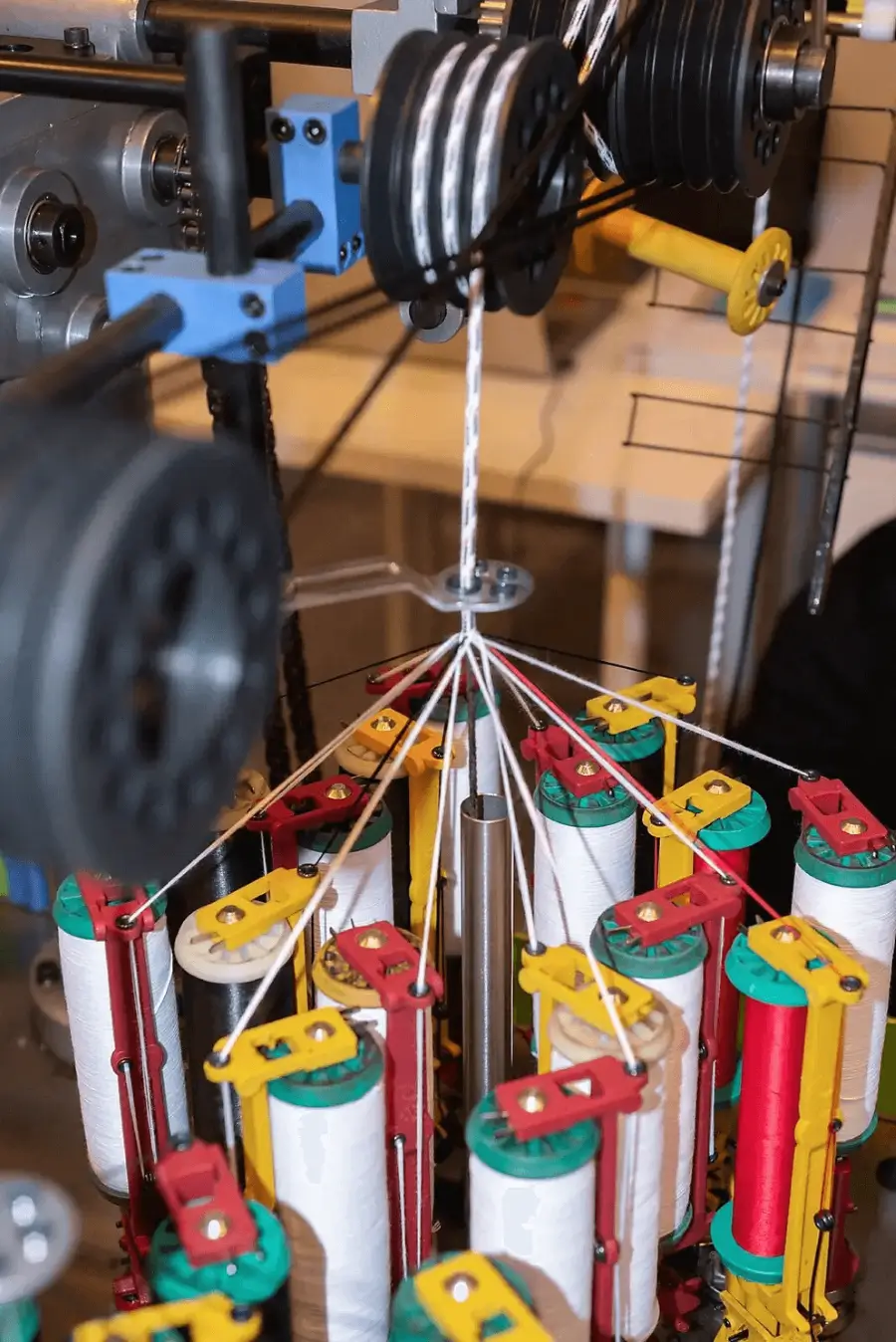
Count the crossovers and check the pick angle. A uniform braid shares load evenly across every yarn bundle; an uneven braid overloads three strands while two go slack. Run your hand along the line and feel for tight and loose sections. On any factory floor, the clearest evidence of a real quality assurance program is machine consistency.
- Pick Spacing: Measure crossovers per 100mm at three points; drift over 5% points to tension problems during braiding.
- Strand Slack: Tension two meters of line and look for any strand sitting low while its neighbors sit high.
- Round Profile: Check the rope stays round under load — a permanently flattened section indicates crushed yarn or a poor setup.
4. Coating Chemistry and Dry Treatment
Coating exists to resist abrasion and keep grit out — it is not a measure of strength. A correct polyurethane or marine finish is absorbed into the braid, not applied as a surface layer. Scrape a sample with a thumbnail: quality coating holds, cheap coating flakes. Coating is often the deciding factor in a dock or mooring application — whether a line survives three seasons against a concrete fairlead.
- Penetration Depth: Cut a sample and check for finish under the braid, not just on the outer yarns.
- Flex Retention: Bend the line sharply — a coating that cracks white was applied too thick or too brittle.
- Grit Shedding: Work wet sand into a test section, flush it out, then open the braid and check how much grit made it through.
5. Splice Bury Length and Termination Craft
This is where quality is decided. For a standard 12-strand construction, a bury of around 21 fid lengths is the commonly used industry reference, with a taper on the tail for a smoother load transfer than a single cut-off shoulder — but always confirm the bury length against the manufacturer’s tested specification and the applicable standard. Short buries slip after months under sustained tension. Remove the whipping and measure; a splicer confident in their work will let you check it with the fid.
- Taper Quality: Look for a gradual reduction in strands into the buried tail — a blunt taper is a stress riser and fails early.
- Whipping Neatness: Tight, even whipping across the splice throat means the rigger was thorough; sloppy whipping means someone was rushed.
- Thimble Fit: The thimble should sit snugly in the eye with no gap — a loose thimble lets fiber contact the hardware’s edges.
6. Diameter Consistency and Linear Density
Weight per 100m tells you whether you got the rope you paid for. If the chart says 12mm should weigh 8.8 kg and your spool weighs 7.9 kg, yarn was left out somewhere. Confirm the supplier holds a tolerance of ±5 ktex, and weigh a sample on delivery. This check catches the most common quiet downgrade on this list.
- Sample Weighing: Cut and weigh a 10-meter sample, compare it to the published ktex figure, and only accept delivery once it checks out.
- Caliper Sweep: Measure diameter at 2-meter intervals across a 10-meter sample and record the range.
- Tolerance Written: Put a ±5% linear-density tolerance in the contract, making a short-weighted delivery a rejectable fault.
7. Creep Behavior Under Standing Tension
Under sustained load, HMPE fiber can elongate slowly over time — this is creep, a time-dependent, permanent elongation that only becomes significant when the rope isn’t unloaded. A line held at 20% of MBL in sustained tropical heat behaves very differently from the same rope taking a 30-second dynamic pull: sustained load and elevated temperature are what drive creep, not peak load alone. Always check creep data against the actual load fraction and temperature for the application, for mooring, guying and other permanent rigging.
- Load Fraction: Ask for creep rates at 10%, 20% and 30% of MBL — the curve rises steeply, not linearly.
- Temperature Stated: Confirm the test temperature. Creep rates rise sharply with sustained service temperature, so a figure quoted at room temperature won’t reflect performance in a hot environment.
- Grade Alignment: Match fiber grade to duty — DM20-class for standing tension, standard SK78 for cyclic, short-duration jobs.
8. Heat and Abrasion Performance at Contact Points
The melting point of HMPE is close to 145°C, and a winch brake drum or a fast-surging capstan can easily reach that temperature. Quality lines come with heat-resistant sleeving already fitted at the drum base and fairlead. Scrub the line across a steel edge 50 times and check for glazing — fused, shiny fiber is heat damage, and it doesn’t recover.
- Sleeve Specification: At any brake or friction contact zone, the first 3 m are covered with aramid or heavy polyester sleeving.
- Glazing Test: Run a friction test and look for translucent, hard spots — localized melting that sits well below the load where visible failure would occur.
- Duty Cycling: Agree on rest time between powered pulls so the drum doesn’t accumulate heat beyond the fiber’s softening point.
9. Color, Marking, and Field Identification
Color is a working tool, not decoration. A black line hides grease well, but it also hides glazing and is harder to read under UV light. On multi-line decks, different-colored lines are commonly run to separate bitts so one line isn’t surged into another by mistake. Whatever the color, quality is judged the same way — by how evenly the pigment has been impregnated into the yarn.
- Pigment Depth: Cross-section a sample and inspect the color through it — surface-dyed yarn turns gray after a single season.
- Tracer Yarn: Look for a tracer yarn identifying batch and grade, for when the label is gone.
- Fade Baseline: Photograph new lines next to a color reference card so fade can be assessed against evidence, not memory.
10. Certification, Documentation, and Retirement Criteria
Every line should be certified, documented and retired against written criteria. The one buyers most often skip is the paperwork. ABS, DNV, BV, CCS, ClassNK, LR and RINA class approvals can all be verified with a phone call, and mooring service should be checked against OCIMF MEG4 compliance. Retirement criteria need to travel with the rope, not get argued out after a line has already failed.
- Certificate Matching: Verify the certificate number, diameter and batch against both the printout and the tag on the spool.
- Retirement Thresholds: Set a written diameter-loss and cut-strand/glazing threshold for retiring each line, based on evidence, not opinion.
- Inspection Schedule: Keep a documented inspection cycle — before every critical lift, plus a monthly inspection with sign-off and photos.
Spec Sheet Snapshot
| Check | Accept | Investigate | Reject |
| Diameter loss | Under 5% | 5–10% | Over 10% |
| Cut strands (12-strand) | 0 | 1 strand, localized | 2+ or clustered |
| Surface fuzz | Even, light | Heavy, localized | Fused beneath fuzz |
| Glazing | None | Small patch, separate | Hard transparent band |
| Splice bury | 21, tapered | 18–20 | Under 18 or slip |
| Linear density | Within ±5% | 5–8% under | Over 8% under |
Which Quality Checks Matter Most for Your Application?
Validating tailored HMPE rope quality checks.
It comes down to whether your load stands still or slams. Standing loads make creep, coating and splice bury the priorities. Shock loads make elongation, heat resistance and abrasion protection the priorities. A good rope, judged against the wrong checklist, will look wrong even when it isn’t.
For marine mooring, the key considerations are MEG4 compliance, snap-back behavior, and jacket abrasion at the fairlead — chafe sleeving should always be a line item in a mooring rope specification. For anchor rope, buoyancy at a specific gravity of 0.97 matters, keeping the anchor rope clear of the propeller.
Vehicle towing is a different case. An HMPE winch rope needs very low elongation and protection from drum heat; an HMPE tow rope may need a nylon tail splice for shock absorption.
| Application | Construction | Priority | Requirement |
| Ship mooring | 12-strand + tail | High, marine grade | MEG4 + class cert |
| Offshore lifting | Heat-set, jacketed | Medium load | Test report |
| 4×4 winching | 12-strand bare | High, abrasion | MBL test data |
| Fishing / trawl | Coated 12-strand | Very high | Batch certificate |
| Dynamic rigging | Dual core | Low | Creep data |
Specialist roles need honest limits. A specification for static loading is comparatively simple; a dynamic-load specification typically calls for a blended or tailed construction. Life-safety climbing is a separate case, and is not recommended unless the rope is specifically engineered, tested and certified to the applicable climbing standard — an auxiliary or utility line built from HMPE blends is not a substitute, given its limited energy-absorption characteristics. For that reason, we don’t recommend HMPE rope for life-safety climbing use.
Small-diameter niches have their own priorities. For fishing line applications, coating uniformity is the main quality factor, and a braided HMPE line offers sensitivity with near-zero stretch. A paracord-style HMPE product with a sheath is generally suited to utility work, not load-rated uses.
Field Tips That Extend Service Life After Delivery
These are the after-sale habits that extend service life. Rope is a one-time purchase — from there, it’s either preserved or destroyed. The recommendations below come from Duracordix’s own field inspection records: lines still in service after five years, and lines that failed within a single season. They reflect our field experience, not an industry-wide study.
Wash the grit out.
Salt crystals and silica in the braid act like a file every time the line bends, so use fresh water, mild detergent and air-dry it out of the sun.
Rotate end for end.
Change the working end every couple of months. Wear concentrates on the first few meters off the drum, and rotation spreads it out.
Carry a repair kit.
A proper HMPE rope repair kit includes a hollow fid, ceramic scissors, whipping twine and tape. A dedicated jacket repair kit lets you fix a covered build before grit reaches the core.
Keep away from light, and keep the ventilation.
UV and trapped moisture both shorten service life. A rack with the line coiled loosely beats a bag on a wet deck every time.
Log the hard pulls.
A line is aged by shock events and hours under sustained, high tension. Use hours under load, not years elapsed, as the trigger for retirement.
Pro Tip: Paint a reference mark on the line at install time and measure the spacing four times a year. The simplest way to know if it’s stretching is to look at it.
Practical Recommendation: Where Buyers Go Wrong and What Works
These recommendations come from recurring purchasing and field-service issues — where buyers get it wrong, and what actually works.
The Sourcing Mistakes We Keep Seeing
- Price-First Filtering: Sorting a supplier list by price alone tends to select for the lowest-grade fiber, the thinnest coating and the shortest bury on the market.
- Convenience Buying: Buying from whichever distributor is nearest is a matter of convenience, not capability — local stock often comes with no batch test data behind it.
- Marketplace Listings: A listing with no grade, no ktex figure and no certificate is selling a picture of a rope, not a specification. Read the spec before ordering from any marketplace.
- Review Dependence: Online reviews typically speak to shipping speed and packaging, rarely to service life or creep performance — treat them as a minor signal, not a substitute for test data.
What Actually Belongs in Your Specification
- Grade and Batch: Fiber grade, producer, and batch-matching across paired or multi-line orders.
- Tested Load Data: A dated break test on a spliced sample, signed off before the balance is released.
- Termination Detail: Rather than specifying “eye splice both ends” and hoping for the best, write out the termination detail — bury length, taper, thimble type and sleeve.
- Protection Package: Order chafe sleeve, heat sleeving and repair consumables up front, before chafe damage shows up six months in.
- Documentation Set: Request written retirement criteria, class certificates and ktex tolerance confirmation with the order — treat any listing without them as incomplete.
What Determines HMPE Rope Price
Price depends on more than diameter. The main factors are:
- Fiber grade
- Diameter and MBL
- Construction
- Coating
- Splice / termination
- Certification
- Quantity
- Packaging
- Destination
- Required lead time
Compare offers on cost per tested kN over the expected service life, not on cost per meter alone — a cheaper line that fails in half the time is rarely the better deal.
Duracordix Capability: A Solution Partner, Not a Spool Seller
Duracordix: engineering quality certified synthetic ropes.
Duracordix is more than a rope company. We are a professional synthetic rope solution provider, and it shows in the things we do before a single meter is braided.
Engineering and Application Matching
- Working Condition Review: Load, angle, environment and hardware are evaluated at the outset, and we recommend the material, rope structure, diameter and MBL based on your duty cycle.
- Termination Design: Eye splice geometry, thimble selection and protective sleeve placement are engineered for the application, across marine mooring, offshore, towing, lifting, fishing and aquaculture, 4×4 recovery, industrial safety and construction.
- Custom Specification: Built to order — color coding, length, coating formulation and marking, such as a green line and a white line spec’d for the same deck for instant identification at a glance.
- Packaging and Delivery: Reel type, labeling, certificate packing and delivery coordination are planned into the order, removing the need to improvise at the delivery site.
Quality Control, Testing, and Certification
- In-House Production: We handle braiding, coating, heat treatment, splicing and testing under one roof, so no process is subcontracted or beyond our control.
- Destructive Break Testing: Batch samples are tested to destruction in-house, and the data ships with the order instead of sitting in a drawer.
- DMX Coating: In our own testing, this proprietary coating has shown roughly 20% higher abrasion resistance, extending service life in high-friction fairlead and drum contact areas.
- Class Society Support: Classification certificates from ABS, DNV, BV, CCS, ClassNK, LR and RINA are available, with MEG4 alignment for mooring applications.
- Raw Material Control: We inspect raw materials against quality standards before they enter production; batches that fall short are set aside or returned.
Production, Service, and Commercial Support
- Capacity and Lead Time: Solution confirmation within 3–5 days, sample evaluation within 7–14 days, and bulk manufacturing scheduled to your project timeline.
- Sample Evaluation: Before committing to volume, test under actual load conditions and construction — a bench test beats a brochure.
- Multi-Industry Coverage: Marine/offshore, construction, fishing, military, agriculture and entertainment rigging are all served from the same production source, removing cross-supplier compatibility issues.
- After-Sales Engineering: Inspection guidance, retirement criteria and failure analysis continue after delivery, with responses measured in hours, not days.
- Honest Limitations: We’ll tell you when nylon or polyester is the better fit for the job — anything less would cost you operationally and cost us our reputation.
Related Products Worth Specifying Alongside the Line
For Marine and Mooring Decks
- Mooring Pendant Sets: HMPE Mooring Pendant is supplied in matched sets of 6’, 8’, 10’ or 15’, with MBL ranging from 121 kN to 1,158 kN.
- Main Mooring Lines: Marine Mooring Rope is manufactured to MEG4 specifications and coated with DMX for greater abrasion resistance at the fairlead.
- Snap-Back Protection: Anti Snap Back Mooring Rope uses an internal arrestor core to reduce recoil if the line parts.
- Offshore Terminals: Single Point Mooring Hawser provides single-leg and grommet MBL data for sizes from 80mm up to 256mm.
- Lifeboat Safety: Fall Prevention Device is built from 24mm 12-strand HMPE with a 30T breaking strength, meeting IMO and SOLAS standards.
For Recovery, Lifting, and Fishing
- Vehicle Recovery: Synthetic Winch Rope in 5mm to 64mm diameter, with a 3/8” build rated at over 18,000 lbs and markedly lower recoil energy than steel cable — reducing, though not eliminating, whip-back risk if the line parts.
- Connection Hardware: Soft Shackle sizes from 1/4” (4,500 kg) to 3/4” (43,000 kg) are available as a steel-shackle replacement, removing the impact hazard of a metal connector.
- Towing Duty: UHMWPE Towing Rope spans 12mm to 96mm diameter, with 455 tons breaking strength at the top end.
- Overhead Lifting: Lifting Sling rated from 3,260 lbs vertical at 11mm up to 13 tons at 36mm, in the color coding your lift requires.
- Commercial Fishing: Trawl Warps in a coated 12-strand construction give high abrasion resistance and low stretch through repeated haul cycles.
Related In-Depth Guides
This guide is meant as the starting point for HMPE rope quality. We’re building out deeper, single-topic guides covering: HMPE Rope MBL & Strength Testing; SK75 vs SK78 vs SK99 Fiber Grades; HMPE Rope Splicing; HMPE Mooring Rope & MEG4 Compliance; HMPE Winch Rope Selection; HMPE Towing Rope; Coating & Abrasion Resistance; Creep in HMPE Rope; Inspection & Retirement Criteria; and HMPE Rope Certification. Check the Duracordix resource center as these are published.
People Also Ask
What Does HMPE Stand For In Rope?
High Modulus Polyethylene. It’s a gel-spun polyethylene fiber made of aligned molecular chains, giving tenacity similar to steel wire at about 1/7 the weight.
How Can You Tell If HMPE Rope Is Good Quality?
Check: fiber grade certificate, tested MBL on a spliced sample, splice bury length, coating penetration, and linear density within a ±5% tolerance.
Does HMPE Rope Float?
Yes. Its specific gravity is below that of seawater, so the line floats — helping it avoid propeller entanglement and seabed snags while deployed.
How Strong Is 12mm HMPE Rope?
Approximately 12.12 tons / 121 kN in a 12-strand construction. Actual figures depend on fiber type and construction, so always refer to the supplier’s tested batch figures.
Does HMPE Rope Stretch?
Barely. Elongation is around 3–4% at break, compared with 20–30% for nylon. The tradeoff for that low stretch is minimal shock absorption, in exchange for very accurate positioning.
How Long Does HMPE Rope Last?
Typically around 5 years of commercial service life under normal, well-maintained conditions — though this varies significantly with load history, heat exposure and grit contamination. Always assess against inspection and retirement criteria rather than age alone.
Can HMPE Rope Be Spliced By Hand?
Yes. A 12-strand single braid splices in minutes with a hollow fid; a 21-fid bury with a tapered tail is needed for full strength retention.
Does HMPE Rope Melt?
Yes, at around 145°C. Winch brake drums and fast-surging capstans can easily exceed that, which is why heat sleeving at contact points matters.
Is HMPE Rope UV Resistant?
Reasonably, yes. It outlasts nylon under UV exposure, and pigmented or coated lines add further resistance. Store the rope covered when not in use.
Can HMPE Rope Be Used Underwater?
Yes. Water absorption is effectively zero, and wet strength matches dry strength — well suited to mooring, submerged rigging and aquaculture.
Why Is HMPE Rope Expensive?
Gel-spinning is an energy- and time-intensive process. Higher grades, coatings and certification add cost up front but typically extend service life enough to offset it.
What Safety Factor Should HMPE Rope Use?
Commonly used reference safety factors are around 2:1 for towing and 5:1 for lifting. Mooring should follow OCIMF MEG4 guidance. In every case, defer to the applicable class society or regulatory requirement.
Does Coating Really Improve HMPE Rope?
Yes, for abrasion resistance. In Duracordix’s own testing, a quality coating has increased abrasion resistance by roughly 20% and reduces grit migration into the braid. It adds no tensile strength.
How Do You Store HMPE Rope?
Dark, dry, clean and ventilated. Rinse out salt and grit, dry it out of the sun, and store it on a rack to drain.
Conclusion
The highest number on a spec sheet never saved a rope. Verified HMPE rope quality comes down to fiber grade, coating, splice bury and certificate — check those four before any money moves.
Request a Quote — for buyers who already know their specification.
Send Your Rope Specification — for engineers who need technical matching.
Ask an Engineer — for buyers who aren’t sure which construction or diameter they need.
Whichever path fits, start by requesting Duracordix’s batch test data for your exact size. Buy HMPE rope quality once, rather than buying rope you can’t trust twice.
About The Author

Moses Xu
VP & Technical Marketing Director
With over 10 years of hands-on experience in high-performance synthetic fiber technology, I help global clients—from professional racing teams to maritime engineering companies—to create unique and special fiber solutions by using high-performance UHMWPE, Kevlar, Nylon fiber, etc. Let’s help you for the next project and solve all your pain points together
 English
  Español
  Deutsch
  Français
  한국어
한국어  Русский
  Português
  Suomi
Suomi