A proper mooring buoy setup requires accurate math for your boat weight and the local water forces. You must include the peak tidal flow and the storm surge. You need a Scope Ratio of at least 3 to 1 in calm water, and 7 to 1 in rough ocean areas. The Working Load Limit must equal 3 times your calculated pull force for the underwater anchor system.
Introduction
A proper mooring buoy setup protects your boat from severe weather and dangerous water currents. Many boat owners lose their vessels because they use weak chains or the wrong anchor shape. This guide explains the technical details for safe marine anchoring. You will learn the best methods to secure your gear and protect your investment.
Understanding the Core Mooring Buoy Setup!
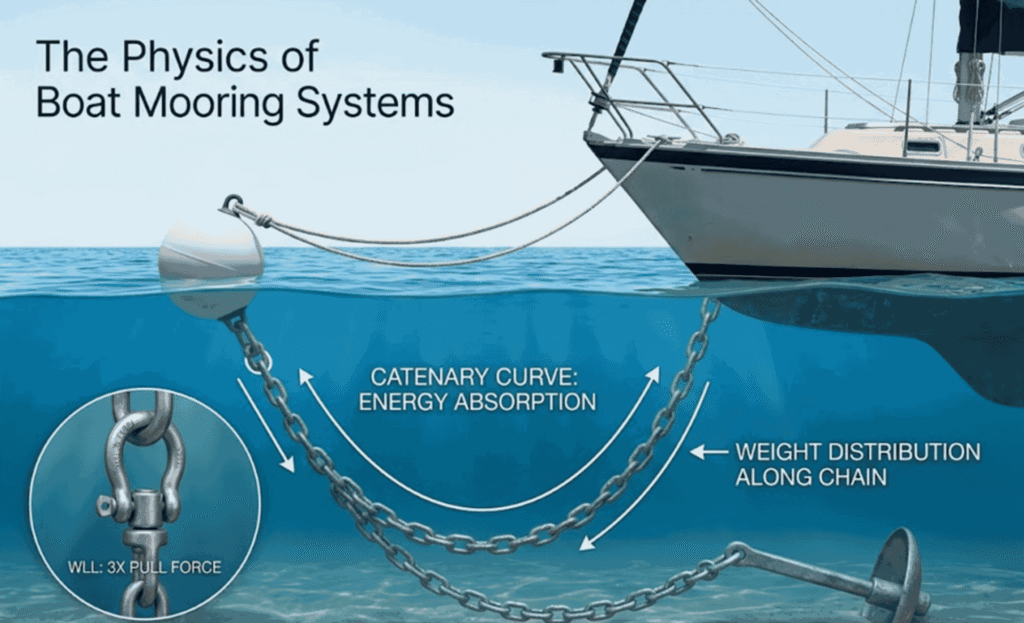
Diagram illustrating the physics of boat mooring systems underwater.
A well-designed mooring buoy setup requires accurate math for your boat weight and the local water forces. You must include the peak tidal flow and the storm surge, or your expensive gear will break.
I remember a massive storm in 2018 when my own boat almost drifted away because I ignored the peak tidal flow numbers. You must learn about the different types of mooring buoys before you buy the heavy gear.
The Physics of Boat Mooring Systems
Boat mooring systems absorb shock and they spread the heavy weight across the entire underwater chain. The gear needs to flex during high wind loads so the metal hardware does not snap. Have you checked the exact snatch forces that your bow cleats can handle before they rip off your deck?
- Catenary Curve: The heavy bottom chain creates a deep curve that absorbs the shock energy before it reaches the anchor.
- Scope Ratio: You need a ratio of at least three to one in calm water, and you must increase it to seven to one in rough ocean areas.
- Working Load Limit (WLL): The safe weight limit of each metal shackle and swivel must equal three times your calculated pull force.
- Kinetic Energy Dissipation: The underwater gear must turn the wave energy into a lifting motion on the chain instead of pulling hard on one single spot.
- Yawing Reduction: A good bridle placement stops the boat from swinging wildly, and this reduces the dangerous side pressure on the main swivel.
- Real-World Scenario: A large forty-foot sailboat in a bad storm could face over four thousand pounds of pull force if the chain straightens out and breaks the small hardware.
Assessing Local Environmental Variables
When you start setting up a mooring in a new area, you must study the local weather and the exact ocean geography. Viking Anchors notes, “Anchors behave very differently depending on the bottom type.”
- Depth at High Water Springs (HWS): You must measure the water depth during the highest tide to find the total chain length you need.
- Seabed Composition: You must change your anchor choice based on the thick mud or the hard sand or the solid rock on the ocean floor.
- Fetch: The highest shock loads will change based on the large distance of open water where the wind builds up the big waves.
Compliance and Mooring Buoy Rules
You must study the local mooring buoy rules before you drop any heavy metal hardware into the ocean water. According to OCIMF guidelines, mooring hardware must withstand the line’s breaking strength.
- Permitting: The local harbor master must approve your plan, and you must register your exact GPS coordinates with the town office.
- Inspection Intervals: Many local towns force marine inspectors to dive down every six months so they can check the underwater metal parts.
- Tackle Specifications: Some local harbor offices force boat owners to use a thick chain size based on the total length of the vessel.
- Environmental Zoning Limits: You cannot drop a dragging ground chain into protected marine areas or into the sensitive green eelgrass beds.
- Liability Insurance Mandates: Marine insurance companies will deny your storm damage claim unless a certified inspector checks your underwater gear every single year.
- GPS Swing Radius Regulations: The local harbor master will measure the clear swing radius around your boat so they can plan for the changing tides.
- Hardware Retirement Schedules: Many town rules force you to replace your bottom chain every three years even if you do not see any surface rust.
Identifying the Best Mooring Buoy Setup
You will not find one single best mooring buoy setup for every boat, because the gear depends entirely on your specific boat size and the local water. Is your current gear strong enough for the heavy wind pressure hitting your tall boat roof? A DIY mooring buoy setup is very dangerous if you do not know the exact math for the anchor.
- Vessel Length Overall (LOA): You must know the exact total length of your boat so you can buy the correct metal hardware sizes.
- Vessel Displacement: A heavy boat needs a much heavier anchor weight so the wind does not drag the entire rig across the sand.
- Windage Area: A tall boat with a large roof creates a massive amount of side pressure during a heavy rain storm.
- Hull Draft Profile: A deep sailboat hull acts differently than a flat powerboat hull, and this changes the specific elastic rope that you need.
- Bridle Geometry Setup: A boat with two hulls needs a wide bridle system so the rope does not pull too hard on one single point.
- Hardware Galvanic Compatibility: You will ruin your gear very fast if you mix a stainless steel thimble with a galvanized metal shackle in the salt water.
- Shock Absorber Integration: You must use heavy rubber snubbers to absorb the shock after the wind pulls the heavy chain perfectly straight.
- Real-World Scenario: A heavy five hundred pound mushroom anchor will drag through the hard sand very quickly if you attach a tall cruiser boat. I saw a large yacht drag its weak setup across the harbor last July, and it smashed directly into the wooden dock.
Selecting the Primary Mooring Buoy Anchor!
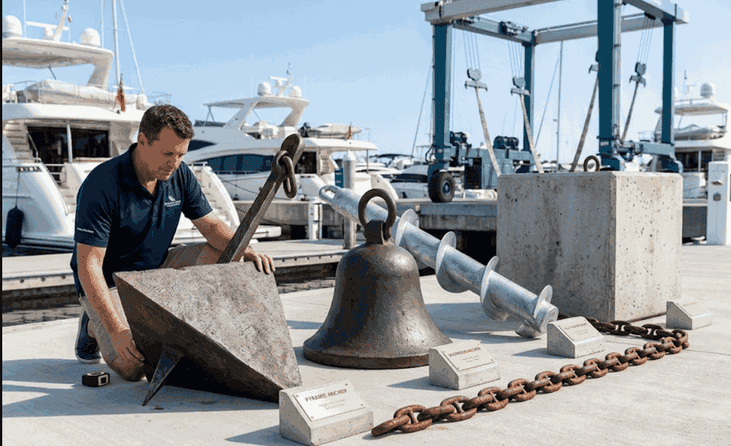
Man kneeling beside different types of boat mooring anchors.
The mooring buoy anchor acts as the main foundation for the entire underwater system. You will definitely drag your boat during a storm if you pick the wrong anchor type for your local ocean floor.
1. Pyramid Mooring Anchor Dynamics
A heavy pyramid mooring anchor pushes deep into the soft mud and the loose sand very fast. The solid iron weight and the sharp point stop the anchor from dragging, and this creates a strong base for your boat.
2. Short Shank Anti-Fouling
The short metal shank stops the heavy ground chain from wrapping around the anchor and tangling the gear. This clever design stops the anchor from pulling out of the mud when the wind spins your boat around.
3. Hydrodynamic Suction Effect
The wide and angled base plates create an amazing grip when they sink deep into the soft ocean mud. This sinking action creates a tight vacuum seal on the sea floor, and you need extreme lifting power to break the anchor free.
4. Precise Sizing Protocols
You must never guess the anchor size when you plan the heavy gear for your new boat. You must look at a proper sizing chart and match your exact boat length and weight to find the perfect holding power.
5. Mushroom Anchor Limitations
A classic mushroom anchor needs very deep and sticky mud so it can create the necessary drag resistance. The massive iron bell must bury itself completely under the soft mudline to hold your heavy chain tight against the strong waves.
6. Extended Settling Duration
A mushroom anchor does not give you instant holding power right after you drop it into the deep water. The heavy iron bell might take many weeks to sink deep into the mud, and you must wait before you attach your large boat.
7. Rotational Breakout Risks
The older anchor designs can fail completely and pull out of the mud during a very violent storm. A sudden change in the wind direction can flip the heavy iron bell out of the mud and drag your boat away.
8. Concrete Deadweight Physics
A concrete mooring anchor relies entirely on extreme gravity and flat suction because it cannot dig into the hard ground. This simple concrete block works very well on a solid rock bottom where a sharp anchor cannot push into the tough earth.
9. Submerged Weight Penalty
A standard concrete block loses almost half of its heavy weight when you drop it into the salt water. You must do the exact math to make up for this water lifting force when you build your heavy dry concrete block.
10. Massive Scaling Requirements
You need a massive amount of concrete space to secure a standard forty foot cruising boat in the open water. You must pour and drop a massive ten thousand pound concrete block to match the grip of a sharp metal anchor.
11. Hydraulic Helix Installation
A modern hydraulic helix mooring anchor needs a special marine work boat and professional workers for the safe installation. The workers use a strong hydraulic machine to spin the long steel shafts deep into the sea floor, and they bypass the soft mud.
12. Maximum Holding Capacity
The deep helix systems give you amazing security after the workers screw them tightly into the hard ground. They can hold five times more weight than a basic concrete block, and they leave a very small mark on the clean ocean floor.
13. Substrate-Specific Deployment
The metal helix shafts must push through the tough dirt so they can reach their maximum rated holding power. The system works perfectly in hard clay and packed sand, but you cannot use it if solid rock blocks the spinning metal shaft.
| Anchor Class | Substrate Profile | Hold:Mass Ratio | Submerged Mass Loss | Settling T(hrs) |
| Cast Iron Pyramid | <1.5 g/cm³ Mud/Sand | 10:1 | 12% | <24h |
| Cast Iron Mushroom | >1.8 g/cm³ Deep Mud | 3:1 | 12% | 336h-504h |
| Concrete Deadweight | >2.5 g/cm³ Solid Rock | 0.5:1 | 45% | 0h |
| Hydraulic Helix | >2.0 g/cm³ Clay/Sand | 50:1 | 0% | 0h |
Primary Mooring Anchor Technical Specifications!
Specifying Mooring Materials and Tackle!
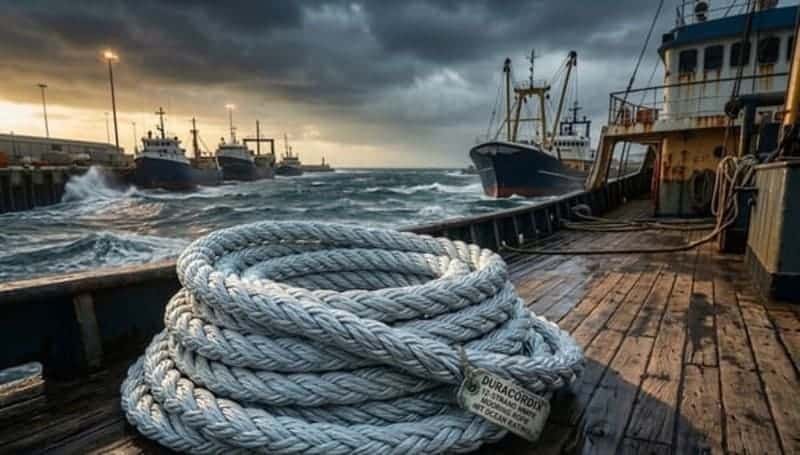
Thick coiled mooring rope on a wooden boat deck.
It is very sad when cheap metal hardware breaks and ruins the trust between the boat owner and the marine supply store. You must review a mooring buoy setup diagram so you can understand how every single part absorbs the massive wave energy. You can buy the best heavy-duty shackles directly from Duracordix to keep your gear safe.
Ultra-High-Molecular-Weight Polyethylene (UHMWPE) Lines
Some new gear requires a very strong buoy mooring line so the boat stays safe in extreme ocean weather conditions. The twelve strand ropes give you the absolute best pulling strength and long life for your heavy boat.
- Load Capacity: The factory designs these thick ropes to hold forty eight metric tons of weight without stretching out of shape.
- Salinity Defense: The special factory coating protects the thick rope fibers from the harsh salt water for a very long time.
- Regulation Alignment: The entire thick rope system meets the strict rules for safe commercial marine operations around the busy harbor.
Hot-Dipped Galvanized Ground Chain
The heavy ground chain acts as the main shock absorber on the bottom of the deep sea floor. You must use hot dipped galvanized steel so the heavy chain does not rust quickly in the salt water.
- Catenary Curve: The heavy metal chain makes a deep curve that stops the fast wave energy before it hits the bottom anchor.
- Wear Troubleshooting: Replace the bottom chain section right away if the metal links look very flat and worn down.
- Sizing Standards: Your metal chain links must be very thick so they can resist the constant rubbing action for many long years.
Forged Steel Mooring Shackles
The metal shackles connect the most important parts of the underwater gear to the main anchor system. You must never use cheap cast iron parts because they will snap quickly under the heavy wave pressure.
- Pin Securing: Lock the metal pin with strong wire so the pin does not spin loose from the constant shaking.
- Load Ratings: The safe load rating of the metal shackle must be much higher than the breaking strength of your main chain.
- Inspection Reality: You must replace a missing safety wire right away or the main metal shackle will open up and drop your boat.
Heavy-Duty Mooring Swivels
The strong metal swivels stop the heavy chain from twisting into a bad knot that will break your gear. You must place this important metal part safely between the floating buoy and the heavy underwater riding chain.
- Rotational Freedom: This part lets the boat swing in a full circle when the wind and the fast tides change direction.
- Component Forging: Buy heavy drop forged steel with a thick galvanized coating so it survives the harsh ocean salt water.
- Maintenance Scenario: Clean the metal swivel with acid and fresh grease if the thick ocean barnacles stop it from spinning.
Nylon Mooring Pennants
The soft nylon rope creates a stretchy link from the floating buoy ball to your strong deck cleats. Nylon remains the absolute best rope material because it stretches very well under the extreme heavy wind. You must learn how to use a mooring buoy correctly so you do not damage your expensive boat.
- Kinetic Absorption: The soft rope stretches very far when the wind blows hard, and this stops the sudden pulling on your boat.
- Dual Configuration: Always use two separate ropes at the same time so you have a safe backup line in a storm.
- Sizing Protocol: Pick the right rope thickness because a rope that is too thick will not stretch out enough.
Heavy-Duty Chafe Gear
The thick chafe gear acts as strong armor for your soft nylon ropes. The rough boat parts will cut the nylon very fast if you do not cover the rope with a strong sleeve. The Log Newspaper notes, “Chafing gear serves as a sacrificial layer between vulnerable lines and surfaces.”
- Material Selection: Use a thick rubber tube or a tough fabric sleeve to stop the constant rubbing against the metal.
- Fixation Method: Lock the protective sleeve onto the soft rope with strong zip ties so it does not slide away.
- Wear Inspection: Replace the protective sleeve right away if you see any ripped fibers on the outside cover.
Galvanized Steel Thimbles
The metal thimbles sit inside the rope loops at the very end of your long mooring lines. They stop the hard metal shackles from cutting straight through the soft nylon fibers of the rope. You must understand the process of attaching buoy ball to mooring chain so your boat stays safe.
- Heavy-Duty Design: Use a hot dipped galvanized thimble because it will not crush under the constant heavy pulling forces.
- Splice Security: Weave the soft rope very tightly around the metal groove so the smooth thimble does not fall out.
- Troubleshooting Fit: You must throw away the nylon rope and make a new loop if the metal thimble cracks under the heavy pressure.
Stainless Steel Seizing Wire
The safety wire acts as the final backup lock for your expensive underwater marine hardware. You must wrap this flexible wire around the shackle pin so the pin does not vibrate out of the hole.
- Grade Specification: Always use marine grade stainless steel wire so the thin metal does not rust away under the water.
- Installation Technique: Push the safety wire cleanly through the small hole in the metal pin and wrap it very tight.
- Inspection Routine: Check the safety wires during every single dive and replace them right away if you see any rust.
Analyzing Types of Mooring Buoys!
There are many different types of mooring buoys and captains must choose the right one for their heavy boat weight.
Traditional Buoy Balls
The normal marine buoy system uses a strong round float and the workers build it for everyday boat anchoring tasks. The factory makes these solid units with thick plastic shells and they fill the inside with special closed cell foam. This double layer design lets the boat hit the outer shell and the heavy float will never fill with water. The system must hold the heavy chain weight during high tides and the strong float must stay above the water.
- Construction: The hard plastic outer shell offers excellent protection and it stops damage when the heavy boat hits the float.
- Hardware Integration: The builders place a metal tube in the center and workers push the heavy steel rod through this hole.
- Buoyancy Requirement: The large float must hold the heavy metal chain and the round ball must never sink under the water.
Spar Buoys
Some ocean areas have thick moving ice and mariners must use a tall round buoy in these fast moving currents. The long shape helps the float sit straight up in the deep water and this stops the fast current drag. Boat drivers can see these tall markers very easily when the ocean gets rough or when the thick fog rolls in. The heavy winter ice slides right past the thin shape and the strong float does not break in the cold.
- Design Profile: The tall shape rides high above the moving water and this avoids the terrible damage from the fast surface current.
- Visibility Factor: The large vertical profile stands very high and mariners can see the tall marker in the worst ocean storms.
- Winterization: The thin shape survives the terrible winter ice flows and crews do not need to remove it in the winter.
Mooring Terminal Buoys
The massive commercial ships use a special mooring terminal to hold their heavy weight in the deep commercial shipping ports. The builders make these massive platforms from thick steel plates and the strong design holds thousands of tons easily. These giant floating steel platforms hold massive chain weights and they survive the extreme shock from the terrible hurricane winds. The local port officials force the owners to follow strict rules and commercial divers must check the underwater steel regularly.
- Scale and Mass: The factory uses massive amounts of heavy steel and this strong metal holds the giant commercial anchor chains safely.
- Fendering Systems: The thick rubber bumpers stop the massive ships from breaking their outer hulls when they approach the steel platform.
- Maintenance Protocol: The port managers force the commercial diving teams to check the underwater steel structures for any hidden rust damage.
Inflatable Mooring Buoys
Many traveling boaters use heavy duty inflatable mooring buoys when they need to anchor their boats for a short time. The factory builds these flexible floats with thick reinforced plastic and the strong material handles the high air pressure easily. Sailors can let the air out of these floats and they can pack them away when they sail the open ocean. These portable floats have thick metal anchor rings and the strong rings absorb the massive shock during a sudden rain storm.
- Material Strength: The builders use thick reinforced plastic materials and the strong shell stays safe under the extreme internal air pressure.
- Storage Capability: Sailors can let the air out of the float and they can store it easily during their long ocean trips.
- Application: These floats work perfectly for temporary boat anchoring and the race managers use them to mark the sailboat race course.
Chain-Through Buoys
Many boat owners use a chain-through buoy for high load anchoring because this smart design offers incredible pulling strength. The heavy ground chain goes straight through the reinforced middle tube instead of connecting to a weak metal swivel underneath.
This direct chain design moves the massive shock energy straight into the ground anchor and it protects the soft plastic float. Boat owners need this solid unbroken chain setup because it provides fast security when the heavy storm winds hit the harbor.
- Load Transfer: The heavy metal chain transfers the massive tension straight into the bottom anchor and this protects the floating ball.
- Hardware Reduction: This smart design removes the weak metal connection points and it solves the problems of a standard rod float.
- Storm Rating: This unbroken chain design gives the maximum security and it holds the heavy boat during the terrible hurricane winds.
Anchor Pendant Buoys
The deep offshore oil rigs use massive anchor pendant buoys to mark their locations and support the heavy bottom chains. The factory builds these extreme floats with very thick steel plates and they weld heavy metal braces inside the shell.
These massive floating units hold giant steel cables and they suspend heavy iron anchors far above the deep-sea floor. These bright markers help the heavy lift boats find the deep-water gear and the crews pull the anchors up safely.
- Construction Standard: The builders use thick steel plates and this strong metal survives the terrible conditions in the deep offshore ocean.
- Suspension Capacity: The giant steel float suspends the massive metal wire cables and the heavy iron anchors above the ocean floor.
- Recovery Operation: The bright marker helps the massive lift vessels find the underwater gear and they pull the heavy hardware up easily.
DIY Mooring Buoy Setup Considerations
The legal risks of building a homemade mooring buoy are very huge and owners should never risk their expensive boat. Builders can buy cheap parts at the hardware store but they must never use weak shackles to rig their heavy boat.
A heavy concrete deadweight anchor needs special marine steel bars so the lifting ring does not rip out during a storm. The marine insurance companies will deny the storm damage claim if the owners use cheap homemade hardware without proper professional safety papers.
- Component Sourcing: The buyers must select the best mooring materials for the underwater anchor system so the heavy chain survives the terrible salt water.
- Concrete Reinforcement: Builders must use special structural steel bars in the concrete and this secures the heavy anchor lifting rings perfectly.
- Insurance Liability: The insurance company will deny the storm damage claim if owners do not have the professional hardware installation papers.
| Buoy Designation | Hull Substrate | Core Architecture | Max WLL(Tons) | Flow Resistance | Target Application |
| Traditional Spherical | High-Density PE | Closed-Cell PU Foam | 5-15 T | High Drag | Harbor Mooring |
| Spar Cylindrical | Steel Composite | Ballasted Air Cavity | 15-30 T | Low Drag | High-Current/Ice |
| Commercial Terminal | ASTM A36 Steel | Compartmentalized Air | 250-500 T | High Drag | VLCC Berthing |
| Pneumatic Inflatable | PVC Thermoplastic | 2-4 PSI Air Cavity | 1-5 T | Variable Drag | Temporary Regatta |
| Chain-Through Tension | Molded PE | Unbroken G80 Chain | 25-75 T | Medium Drag | Hurricane Hold |
| Offshore Pendant | Welded Steel | Internal Cross-Bracing | 500-1500 T | Extreme Drag | Deepwater Rig |
Mooring Buoy Classifications and Technical Specifications!
Operational Protocols: How to Use a Mooring Buoy?
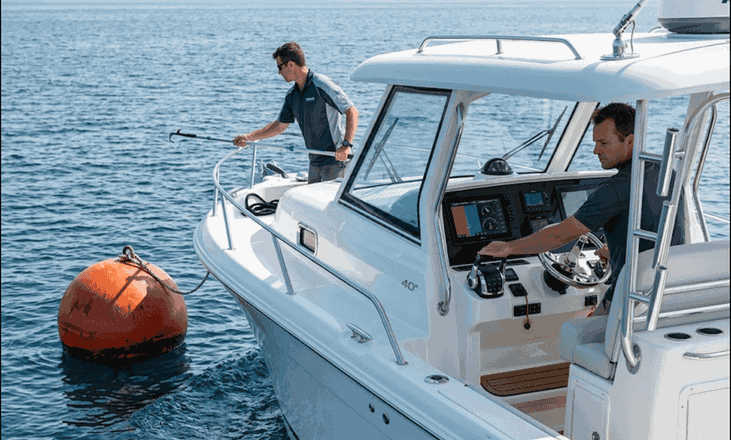
Two men using a boat hook to grab mooring buoy.
Captains must know exactly how to tie up to a mooring buoy so they do not crash into the other boats. Drivers lose their steering control when they drive downwind and this puts the expensive fiberglass boat at a terrible risk. Crews must always pull the soft rope very slowly and they must fight the strong wind and the fast current.
Approach Angles and Velocity
Mariners face a big challenge when they drive the boat and they must control the engine speed during the final approach. Pilots must look at the wind and the water current before they start the final drive toward the floating ball. Drivers must stop the boat and they must try the approach again if they misjudge the strong wind or current.
Vector Assessment and Control
- Wind Vectors: Navigators must determine the exact wind direction and they must see how the strong wind pushes the heavy vessel.
- Current Drift: Lookouts must look at the moving water and they must watch how the fast tide flows around the floating ball.
- Throttle Management: Drivers must keep the boat engine in the lowest speed and they must turn the steering wheel very carefully.
- Neutral Gear: Captains must shift the engine into neutral gear for the last twenty feet so the rope does not hit the propeller.
- Boat Hook: Deckhands must use a long pole to grab the floating rope and they must stay safely on the boat deck.
The Secure Tie-Up Procedure
Sailors must understand the symmetrical mooring rules and they must know the right way to approach the heavy floating ball. Owners must share the heavy pulling force across the strongest metal points on the front of the boat.
The boat will break loose and the vessel will float away if owners tie the rope to a weak deck cleat. I lost my small fishing boat in 2019 because I tied the main rope to a weak plastic deck cleat. Have you checked the metal bolts under your deck cleats recently to see if they are rusting away? According to Tommy Docks, a properly installed cleat keeps your boat secure.
Hardware Attachment Steps
- Cleat Hitch: Deckhands must use a special locking knot on the metal cleat and this secures the main rope perfectly tight.
- Load Distribution: Crews must balance the heavy pulling load evenly between the left side cleat and the right-side cleat.
- Chafe Prevention: Workers must run the soft ropes through the smooth metal chocks and this stops the rope from cutting and breaking.
- Secondary Safety: Sailors must tie a second backup rope to a different metal cleat and this provides safety if the first rope breaks.
- Tension Check: Drivers must run the boat engines backward for a few seconds and this checks the tight connection to the heavy float.
Disconnection and Departure Protocols
Captains must work with the boat crew carefully when they leave the anchor and this stops the ropes from hitting the propeller. Crews must pull all the soft ropes out of the water before they shift the boat engine into the forward gear. Many boat drivers rush this departure step and the thick rope wraps around the metal propeller shaft very quickly.
- Engine Readiness: Drivers must start the boat engines and they must let them warm up before they release the tight rope tension.
- Drift Observation: Lookouts must watch the front of the boat and they must see which way the wind pushes the hull after release.
- Line Clearance: Deckhands must pull the entire soft rope out of the water and they must place it on the front deck.
- Visual Confirmation: Workers must look at the ocean water and they must confirm that no ropes are floating near the back propeller.
- Controlled Exit: Pilots must drive the boat away very slowly and they must push the engine throttle forward with a gentle touch.
Mooring Buoy Rules and Regulatory Compliance!
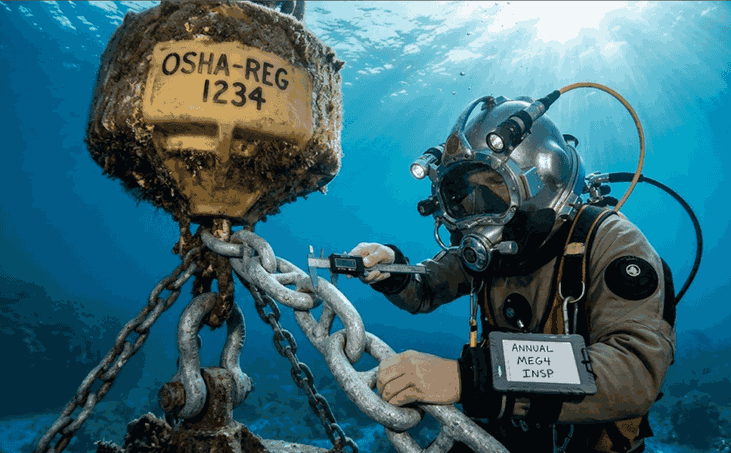
Scuba diver inspecting a heavy underwater mooring buoy chain.
The local harbor police control the floating buoys strictly because they need to fit many boats in the small water space. The police will take the floating ball away and they will give a massive ticket if owners skip the registration.
Owners must give the exact engineering plans to the local marine police before they drop the heavy metal into the water. Are you truly prepared if the harbor police ask to see your underwater inspection papers this weekend? “Regular gear inspections prevent catastrophic vessel loss in crowded marine harbors.”
OSHA and OCIMF MEG4 Guidelines
- Permit Registration: Owners must write the local permit number on the plastic shell and the police can see it from their boat.
- Annual Inspections: Captains must hire a professional diver every twelve months and the diver must check the heavy metal parts for safety.
- Tackle Upgrades: Workers must remove the old chains immediately if they see any rust or if the metal links look very thin.
- Compliance Audits: Drivers must keep the printed hardware safety papers on the boat and they must show them to the police officers.
- Load Testing: Owners must verify that the heavy metal hardware meets the exact safety limits from the approved factory engineering plans.
ISO 4892-2 Standards and UV Resistance
The bright sun destroys the soft plastic marine ropes very quickly when they sit outside in the hot summer weather. The marine rules force owners to buy ropes with special sun protection and the factory tests them for one thousand hours. This strict factory testing gives the ultimate confidence and captains know the ropes will last for at least five years.
- Material Certification: Captains must show the official rope material papers to the port police and they will verify the strong plastic quality.
- Degradation Checks: Deckhands must inspect all the soft nylon ropes four times a year and they must look for hard stiff spots.
- Lifespan Mandates: Owners must throw away all the old nylon ropes before five years pass and they must buy brand new lines.
- Exposure Logging: Sailors must write down how many days the soft ropes sit in the direct sunlight during the hot summer months.
Local High-Salinity Resistance Metrics
The normal steel hardware rusts very fast in the hot tropical weather and the extremely salty ocean water destroys the metal. Builders must construct the underwater anchor system to survive the local salt levels or the heavy chain will break very suddenly.
Did you dive under your boat this month to check the metal shackles for dangerous white rust and severe pitting? According to Practical Sailor, saltwater corrosion accelerates rapidly when hardware remains submerged.
- Galvanized Hardware: Workers must only use the thick hot dipped galvanized steel hardware for every single connection under the salty ocean water.
- Corrosion Monitoring: Divers must measure the exact metal thickness on the steel shackles during the spring dive and the autumn dive.
- Sacrificial Anodes: Mechanics must bolt the soft zinc plates onto the heavy metal structures and the zinc stops the dangerous electrical rusting.
- Salinity Testing: Owners must change the maintenance schedule often and they must match the exact salt levels in their local ocean water.
Installation and Maintenance Protocols!
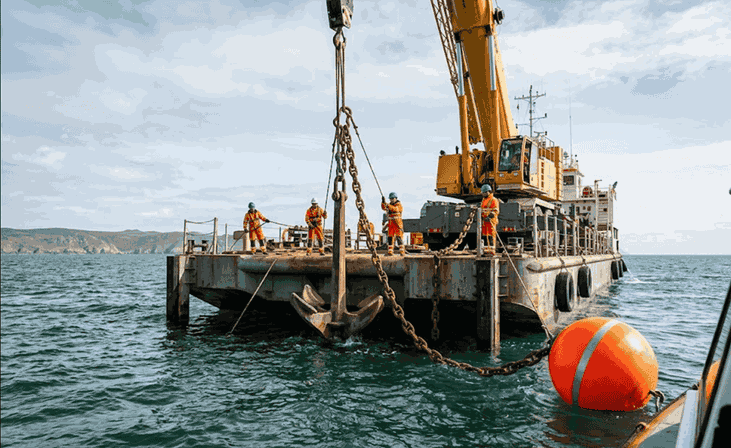
Workers using a crane to lower massive marine anchor.
Workers need special heavy equipment and a perfect GPS location when they want to learn how to install a mooring buoy safely.
The Installation Process
A professional marine company will place the heavy anchor perfectly and they will guarantee that the metal grips the mud tightly.
- Deployment Vessel: The workers drive a massive flat boat and they use a giant lifting crane to lower the heavy metal gear.
- Setting the Anchor: The heavy boat pulls the new anchor with extreme force and this buries the metal deep into the soft ocean mud.
- Documentation: Captains must draw a clear mooring buoy setup diagram and they must list the exact chain lengths for future repairs.
Cost Considerations
The total mooring buoy installation cost changes very drastically and it depends on the specific harbor location and the gear size.
- Hardware Costs: Owners will pay between one thousand dollars and four thousand dollars for the anchor and the chain and the float.
- Deployment Fees: Buyers will pay the workers about one thousand dollars and the price depends on the travel distance and the crane.
- Permitting Fees: Citizens must pay the city office every year and they must pay the professional divers for the underwater safety checks.
Attaching the Vessel
Drivers must learn the safe way to grab the floating ball and this protects the crew members from terrible hand injuries.
- Approach: Pilots must drive the boat toward the float very slowly and they must point the nose directly into the wind.
- Retrieval: Deckhands must use a long wooden pole to grab the soft rope and they must pull the line onto the boat.
- Securing: Sailors must tie the soft ropes to the strongest metal deck cleats and they must never use the weak handrails.
Maintenance and Inspection Schedules
The salty ocean water destroys the thick metal hardware constantly and owners must check the gear to protect the boat. I almost lost my vessel because I forgot to check the bottom chain during my busy summer fishing season last year. Bainbridge Divers expert states, “Regular inspections identify potential issues with mooring equipment.”
- Annual Checks: Crews must inspect the soft ropes and the top metal shackles and the plastic float before the summer season begins.
- Bi-Annual Dive: Captains must hire a diver to check the heavy ground chain and the diver must measure the worn metal links.
- Replacement Cycle: Owners must buy a new riding chain every four years and they must replace the bottom chain every eight years.
Conclusion
A safe mooring buoy setup requires perfect hardware and careful marine planning. Captains must inspect the heavy underwater chains and replace the weak ropes before every storm. Sailors should never use cheap metal shackles because they will break in the salt water. Contact Duracordix right now to buy the strongest marine equipment for heavy boats.
Bonus – Frequently Asked Questions!
Buyers must know the answers to these important questions before they buy the heavy marine equipment for the big boat.
How Do I Calculate The Required Weight For A Concrete Mooring Anchor?
Boaters need one hundred pounds of concrete for every single foot of boat length and they must adjust for the wind. The heavy concrete block contains massive amounts of water and it loses half of its weight in the ocean.
Why Is My Mooring Buoy Sitting Very Low In The Water?
The plastic float is too small to hold the heavy chain or thick sea grass covers the ball and adds massive weight.
What Is The Purpose Of A Swivel In The Mooring Setup?
The heavy metal swivel stops the thick chain from twisting into a bad knot when the boat spins in the changing wind.
How Often Should I Replace My Nylon Mooring Pennants?
Owners must buy new soft nylon ropes every two years or they must replace them if they see any ripped nylon fibers.
Can I Use Stainless Steel Shackles Underwater?
Workers must never use stainless steel underwater because the low oxygen makes the metal rust and break very quickly. Builders must always buy the thick hot dipped galvanized steel hardware.
What Does ‘Scope’ Mean In A Mooring Context?
The scope is the simple math ratio between the long chain length and the deepest water level during the high tide.
How Do I Know What Size Mooring Buoy I Need?
Captains must look at a pyramid mooring anchor size chart and the float must hold the heavy chain above the water.
What Is The Advantage Of A Helix Anchor Over A Deadweight?
The modern helix mooring anchor provides massive pulling strength and it never drags across the sand during a violent hurricane storm.
How Do I Prevent My Pennant Lines From Chafing?
Sailors must slide thick rubber tubes over the soft ropes and the rubber protects the lines from the sharp metal corners.
Do I Need A Permit To Install A Mooring?
Citizens must ask the local harbor police for legal permission and the officers will give them a specific spot on the water.
About The Author

Moses Xu
VP & Technical Marketing Director
With over 10 years of hands-on experience in high-performance synthetic fiber technology, I help global clients—from professional racing teams to maritime engineering companies—To create unique and special fiber solutions by using high performance UHMWPE, Kevlar, and Nylon fiber etc. Let’s help you for the next project and solve all your pain points together
 English
  Español
  Deutsch
  Français
  العربية
  한국어
한국어  Русский
  Ελληνικά
  Italiano
  Português
  日本語
日本語  Türkçe
  Tiếng Việt
  简体中文
简体中文  Suomi
Suomi  Svenska