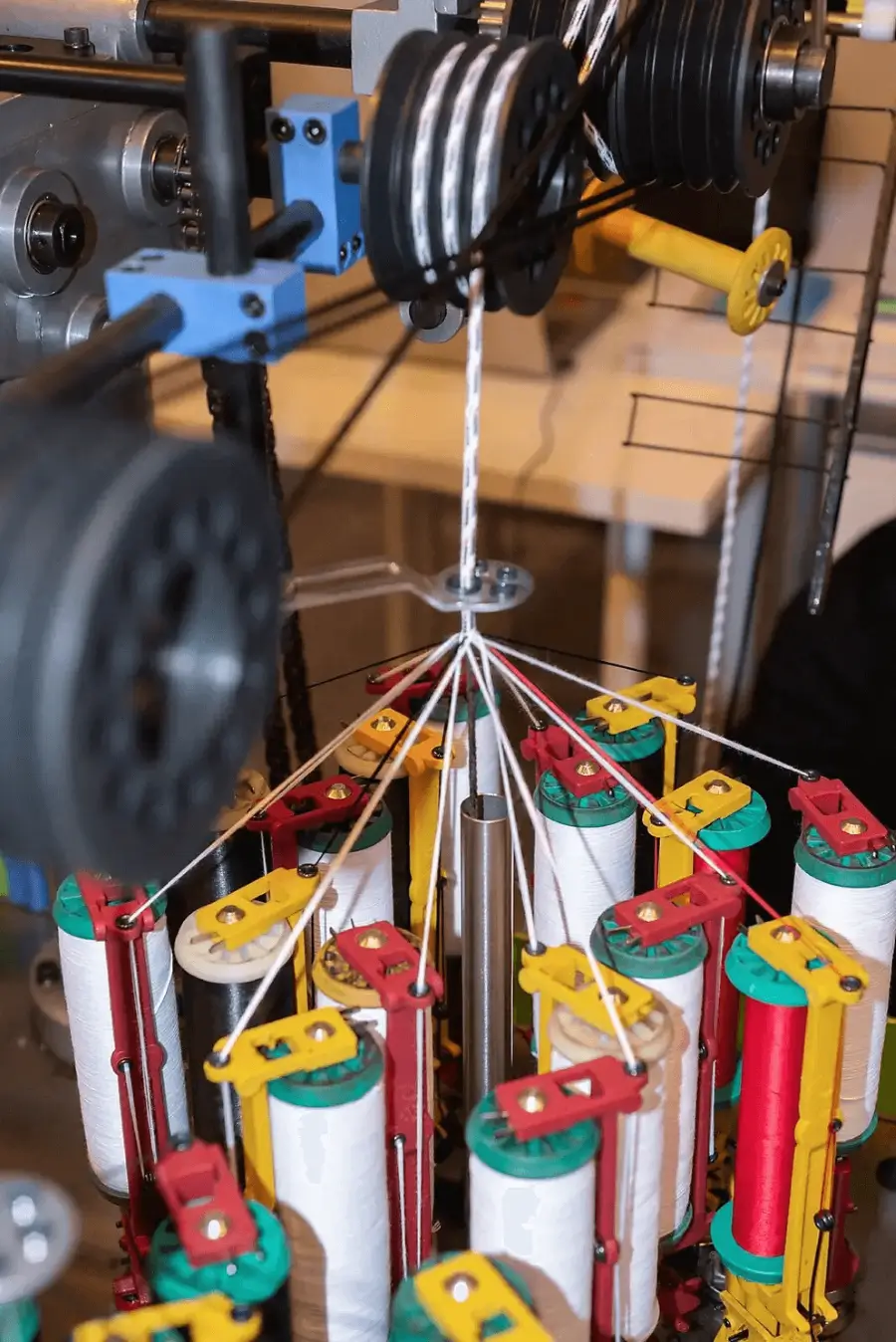
Containment measures today employ proven high density polyethylene configurations. High-density polyethylene offers tough bite-resistant confinement systems. It supports 25 metric tons with no critical failure. Engineers use heavy duty material for aquaculture netting when dealing with multi-ton dynamic loads to comply with OCIMF MEG4 guidelines. The Dyneema net is resistant to 48 metric tons of direct force continuously.
No Wait Anymore! Start Here…
Do high rates of cage breaches ruin your precious aquatic stock? The solution to structural failures is identifying the precise material for aquaculture netting. Operators require UV resistant polymers with high minimum breaking loads. This stops the replacement of worn-out mesh every year. Containment measures today employ proven high density polyethylene configurations.
Defining The Optimal Material For Aquaculture Netting!

Comparison of strong aquaculture netting materials.
Trailblazing through severe tidal surges negatively affects low-quality containment systems on a short-term basis. The existence of low structural integrity in volatile areas makes operators lose tons of biomass each year. The choice of the specific material for aquaculture netting presupposes the analysis of raw tensile strength, biofouling resistance, and local hyper-salinity indicators.
Were you aware of the actual Minimum Breaking Load (MBL) of your current perimeter prior to the next impact of a storm surge? Furthermore, engineers use heavy duty material for aquaculture netting when dealing with multi-ton dynamic loads to comply with OCIMF MEG4 guidelines.
Early in my career, I remember losing an entire harvest because our standard nets simply snapped under the pressure of an unexpected swell. According to InnovaSea, HDPE netting provides exceptional durability for offshore aquaculture operations.
High-Density Polyethylene (HDPE) Mesh
High-density polyethylene offers tough bite-resistant confinement systems, and these are specifically designed to offer protection against heavy marine predators. This polymer provides structural volume in the extreme tidal drag, which eliminates cage destruction due to violent storm surges in the oceans.
HDPE System Specifications
- Tensile Limit: It supports 25 metric tons with no critical failure during operational marine deployment.
- UV Protection: Aquaculture netting made of black material blocks the sun degradation completely and effectively.
- Core Application: It remains preeminent in the commercial aquacultural net pens in the world today.
Ultra-High-Molecular-Weight Polyethylene (UHMWPE)
Ultra-high-molecular-weight polyethylene is fifteen times stronger by weight compared to steel wire. Such high-tech polymers completely remove knot slip, and they improve the distribution of loads during high-energy offshore installations that have harsh oceanic environments.
UHMWPE Performance Metrics
- Breaking Load: The Dyneema net is resistant to 48 metric tons of direct force continuously.
- Friction Reduction: This knife-free construction has eliminated localized abrasive traumatization over an extended duration.
- Standardization: It fully meets the OSHA standard 1918.106 tension requirements for operational marine safety.
Polyamide (Nylon) Mesh Configurations
Nylon provides large elasticity and quick points of sinkage, which can be used in special sweep operations. Nevertheless, untreated variations are destroyed quickly by the tensile process in terms of salinity and continuous cyclic wave loading. Have you considered how rapid degradation impacts your quarterly replacement budgets?
Nylon Operational Deployment
- Sourcing Logistics: Inland facilities are supplied by standard nylon mesh netting rolls from local vendors.
- Submersion Rate: Active nets should be used to cultivate fish rapidly on the aquaculture farm.
- Known Weakness: It picks up ambient water and creates exponential hydrodynamic drag during heavy tides.
Polypropylene Screen Enclosures
Polypropylene buildings present significant and stimulating barrier choices in lightweight and cost-effective freshwater settings of low impact. The material is not subject to chemical degradation, but it needs an instant special coating to endure long exposure to ultraviolet rays without rapid structural embrittlement. The data on polypropylene integration at the WBS level shows clear functional benefits.
Polypropylene Integration Data
- Surface Defense: Aerial predation can be prevented by the use of polypropylene screen mesh material.
- Applied Coating: The poly netting mesh involves the use of cuprous oxide antifouling protective treatments.
- Aperture Sizing: This is a 1 4 inch poly netting that avoids the escape of juvenile biomass.
Polyester (PET) Benthic Containment
Polyester has very low stretch properties, and it forms very rigid containment forms beneath the water. This high polymer is dangerously unresistant to localized abrasion, and it is the main substance in the special benthic traps placed on seabeds.
Polyester Structural Integrity
- Deformation Limits: It retains precision in dimensions with huge 15-ton load stresses applied dynamically underwater.
- Volumetric Flow: The 3 4 netting ensures continuous ambient oxygenation that is massively beneficial for growth.
- Lifespan Guarantee: It offers a 5-year suspension in terms of ISO 4892-2 rigorous weathering tests.
Structural Failure Scenarios & Troubleshooting
Take the North Sea, which is a rough area for extensive marine farm operations. Managers use generic nylon cages that are subject to excessive knot slip in Category 3 storms.
The cyclical loading continually unties and breaks apart traditional knots, which results in disastrous inventory loss. Are train points hand-tied or welded during the initial assembly? Knotless UHMWPE structures can do away with friction points by undergoing a complete structural upgrade.
Data-Driven Material Selection
| Polymer Classification | Minimum Breaking Load | ISO 4892-2 UV Rating | Ideal Localized Deployment |
| UHMWPE (Dyneema) | 48 Metric Tons | 1,000+ Continuous Hours | High-energy North Sea offshore installations. |
| HDPE Containment | 25 Metric Tons | 800 Continuous Hours | Tropical, high-salinity coastal zones. |
| Polyamide (Nylon) | 12 Metric Tons | 400 Continuous Hours | Inland freshwater raceways and ponds. |
How Climate Context Dictates Aquaculture Netting Choice?

Climate factors affecting aquaculture netting decisions.
Localized solutions do not work in hyper-local contexts without proper environmental adjustments. The very salty condition of the Gulf of Mexico kills untreated nylon in mere months.
On geographic reality, aquaculture farming net solutions have to correspond to the actual physical reality. During a site visit in Florida, our team witnessed how a generic net disintegrated within six months due to the intense solar radiation and salinity.
Tropical vs. Cold Water Installations
Hot seas promote rapid marine development around the localized commercial net pen aquaculture farm. Aquaculture mesh netting is easily obstructed by algae and barnacles that suffocate the entire system.
- Tropical Zones: They must have blue aquaculture netting or green aquaculture netting impregnated with special cuprous oxide antifouling overcoats.
- Cold Zones: This technology uses flexible polyethylene nets to inhibit ice crystal embrittling in the sub-zero temperatures of the freezing surface.
- High UV Zones: Black aquaculture netting material has maximum resistance to the breakdown of dangerous solar radiations.
- Inland Freshwater: White aquaculture netting or gray aquaculture netting are only necessary in low UV exposure environments with zero salinity.
Assessing Local Suppliers
Getting access to quality aquaculture netting material locally ensures a decrease in the time taken in the logistics. Find an authorized manufacturer of aquaculture barrier net that meets ISO certification standards. The 255m aquaculture net wholesale shipping entails heavy freight, which means that proximity is a major operational issue.
Core Polymer Types: How To Choose The Material For Aquaculture Netting!

Step-by-step guide for choosing aquaculture netting.
Isolating raw data and marketing adjectives helps polymers compare raw data accurately. Operators must have verifiable specifications for their equipment to avoid failure.
Is your existing aquaculture engineered to contain your target biomass securely? Normal trial and error procurement kills working budgets entirely. We give detailed architectural measures below to ensure your offshore investments are perfectly safe.
Step 1: Calculate Minimum Breaking Load Requirements
Determining the intensity of storms in the region will determine your precise tensile needs. Operators need to establish dynamic drag forces and then choose heavy duty aquaculture netting material to avoid catastrophic offshore containment breaches permanently.
Tensile Strength Benchmarks
- UHMWPE Specs: It sustains 48 tons perfectly without any structural deformation over time.
- HDPE Limits: It resists 25-ton hits of the predators effectively in deep waters.
- Nylon Capacity: It has a unit 12-ton static carrying capacity for standard inland operations.
Step 2: Evaluate Local Biofouling and Salinity Levels
Marine growth occurs exponentially when the nets are located in warm coastal waters. Facility managers need to examine local macro-fouling rates in an effort to understand whether aquaculture farming net solutions should be issued with specific cuprous oxide antifouling chemical treatments at all times.
Marine experts note that biofouling drastically increases hydrodynamic drag on aquaculture nets.
Environmental Defense Tactics
- Tropical Waters: Operators mandate chemically coated polymers for long-term survival in these specific conditions.
- Arctic Zones: These regions require freeze-resistant structural strands to prevent shattering during winter months.
- High Salinity: This excessive salt production kills unprocessed nylon immediately upon marine deployment.
Step 3: Determine Target Species Aperture Sizing
Accuracy in mesh size prevents baby flight whereas the ambient oxygenation is maximized. Engineers determine precise aperture percentages that make your aquaculture netting correspond with the biomass anatomy stages of a particular captive.
Sizing Configurations
- Hatchery Phase: Operators deploy 1 4-inch poly netting for maximum safety and retention.
- Grow-Out Phase: Farmers use flexible 3 4 netting to improve vital water flow.
- Bivalve Maturation: Workers nail rigid clam netting to secure the harvest along the seabed.
Step 4: Implement Tiered Predator Defense Systems
One-layered containment is easily broken by aggressive sea predators hunting for food. The implementation of hybrid barriers that use firm outer meshes and overhead aquaculture bird netting entirely disarm the multi-directional threat of predation in the open ocean installations.
Multi-Layered Protection Mechanisms
- Aerial Defense: Operators put in place netting of predator birds, which are extremely light in weight.
- Subsurface Shielding: Managers implement Dyneema bite-resistant nets for underwater security against marine mammals.
- Benthic Security: Workers attach safety heavy rigid oyster bags at the bottom of the installation.
Step 5: Verify UV Degradation Resistance Metrics
Constant exposure to solar radiation dissolves the unfortified artificial polymers at a very high rate. Procurement teams should insist on black material to be used in constructing aquaculture nets with concentration on carbon black additives to guarantee long ultraviolet structural life.
Solar Resistance Data
- Black Polymers: They block 99% of harmful UV radiation completely to ensure structural longevity.
- Clear Plastics: These clear materials break down in 12 months under direct and intense sunlight.
- ISO Verification: This safety check requires strict compliance testing of ISO Verification 4892-2 standards.
Step 6: Analyze Volumetric Flow and Shock Absorption
It is important that the cage volume should be maintained on heavy tidal shifts to maintain the health of the fish. Operators assess knotless edifice design with strong poly netting mesh to ensure optimum steady hydrodynamic water transaction rates. ResearchGate findings indicate, “The association between the two organic biocides created a synergistic effect on the antifouling performance, further resulting in a prolonged activity.”
Hydrodynamic Performance
- Square Mesh: This specific design maximizes oxygenated water flow throughout the cage system effectively.
- Diamond Mesh: This formation acts as a cyclic wave shock absorber during violent oceanic storms.
- Seamless Joints: These connected joints get rid of friction ripping up the material entirely.
Step 7: Assess Installation Rigging Compatibility
The netting is excellent, but it is ruined by improper mounting structures that occur due to the uneven pull. Make sure whatever specific fabric it is you want to ply your aquaculture netting with must be compatible with your current styles of rigid collars and mooring bracket configurations.
Rigging Integration Variables
- Tension Distribution: This balanced setup ensures an anti-tearing mechanism is fully active during operations.
- Mooring Compatibility: The mooring system must be compatible with OCIMF MEG4 standards for overall safety.
- Weight Ratios: Engineers calculate submerged drag loads carefully to prevent sinking the entire perimeter.
Dimensions & Specifications of Material For Aquaculture Netting!

Dimensions and specifications of aquaculture netting materials.
Raw dimensions determine the success of operations in an unending manner across the industry. There are no large aquaculture netting material that you can deploy without computing the actual current drag profile. Specifically, 3 miles operation of Jurong Port terminals requires a high level of compliance with MPA regulations. We learned the hard way that improper aperture ratios can choke water flow, as our first facility experienced a 20% drop in dissolved oxygen.
Sizing Delivery Formats and Panel Configurations
Aquaculture netting material is often purchased in huge volumes by organized procurement managers. The manufacturer of reliable aquaculture cage nets would mean receiving ready-made panels in direct proportion to the computer-aided engineering design system with precision of structure.
Supply Delivery Frameworks
- Roll Formats: The continuous roll aquaculture netting material removes weak seams completely from the perimeter.
- Pre-Cut Panels: These custom buildings maximize the efficient use of new aquaculture netting material.
- Thickness Metrics: High deniers are determined by heavy duty aquaculture netting material for rough seas.
Aperture Ratios and Localized Mesh Dimensions
Checking definite aperture sizes discourages extreme localized feeding predations among the growing fish. In the sourcing of replacement aquariums material for aquaculture netting, operators need to apply exact measurement criteria to ensure crucial volumetric water oxygen circulation is assured.
Mesh Calibration Standards
- Juvenile Protection: The 1 4-inch poly netting offers protection against the loss of microscopic biomass.
- Mature Containment: The 3 4 netting maximizes ambient hydrodynamic fluid exchange greatly within the cages.
- Bivalve Maturation: Farmers place clam netting comprising hard shells for safety against seabed friction.
Environmental Color Coding and Chemical Coatings
Direct directives of operational deployment areas are determined by visual identifiers on the equipment. Proper sourcing of polymers with defined pigmentation guarantees accelerated safety check-ups and optimal rates of localized deflection of sunlight in high-temperature equatorial sites with installation marine farms which are secure over the world.
Deployment Color Strategies
- Hazard Markers: Orange aquaculture netting material shows maritime hazards in the short term for vessels.
- Solar Defense: Aquaculture netting made up of black material prevents radiation degradation effectively over time.
- Inland Operations: Netting in closed freshwater raceways is completely dominated by white aquaculture options.
Identifying Anti-Predator Material For Aquaculture Netting Options!

Multi-tiered anti-predator netting options.
On aquaculture farms, predators capitalize on microscopic vulnerabilities in your protection net cutting right through it. Perforations in frayed nylon perimeters are easily made by seals on a daily basis. Underinflated aquaculture bird netting designs are continuously penetrated by diving birds.
Your defense architecture needs to be multi-tiered with an implementation of developed high-tensile polymer structures. Is your current defense architecture multi-tiered enough to stop a determined seal breach?
Aerial Defense Netting Deployment
The protection of the surface perimeter prevents the massive loss of stocks with predatory birds immediately. The operators use special polymer-coverings that preserve a vital amount of sunlight entering through but completely deterring aerial assaults of vicious, dive-bombing birds.
Aerial Protection Strategies
- Canopy Setup: Farmers use tensioned netting polyethylene for full installation security across the entire surface.
- Mesh Sizing: A 50mm predator bird netting is highly effective against aerial attacks from seabirds.
- UV Rating: Operators demand black aquaculture netting material only for protection against prolonged sun exposure.
Subsurface Rigid Perimeter Installation
When the predator is under a lot of stress, fish are able to be bitten through thinner polymers in feeding frenzies. The application of secondary rigid containment layers around the main habitat prevents hostile marine mammals before they can gain access to the valuable inner cages.
Subsurface Defense Tactics
- Outer Shield: Operators deploy a firm predator netting heavy layer outside the primary containment ring.
- Strand Core: They use reinforced HDPE netting with stainless steel wire to stop aggressive biting.
- Vendor Choice: Managers contract a certain anti-predator aquaculture net manufacturing company for specialized builds.
Benthic Bottom Tensioning Systems
Predators are always seen consuming the light bottoms of the cages due to the continuous elevation by the ocean currents. The heavy specialized weights placed to secure the bottom structural foundations serve to ensure the cage tension of perfection when excessively huge cyclic influxes of waves occur.
Benthic Anchoring Variables
- Base Anchors: The teams anchor the aquaculture fish nets exhaustively below the water surface.
- Drag Limits: They achieve an accurate commercial net pen aquaculture tension using proper engineering guidelines.
- Material Spec: Workers apply heavy Dyneema nets on the ocean bottoms to prevent benthic tearing.
Predator Defense Data Benchmarks
Assessment of raw material constraints would guarantee that the localized threat posed by marine mammals is unable to penetrate primary cage lines.
| Threat Category | Required Defense Material | Minimum Breaking Load (MBL) | Localized Scenario Fit |
| Sea Lion / Seal | Stainless-core HDPE | 25 Metric Tons | High-impact coastal salmon farms |
| Avian Predators | 50mm Polyethylene | 5 Metric Tons | Shallow draft inland hatcheries |
| Benthic Sharks | UHMWPE (Dyneema) | 48 Metric Tons | Deep-water offshore installations |
Scenario 1: Combating Seal Breaches in Chile
Southern Chile has salmon farms that are attacked by sea lions frequently. Nets of standard aquaculture cages, on which simple braided nylon was used, failed every week.
The soft fibers were easily bitten by the predators. The production was changed to rigid HDPE netting reinforced by stainless steel core wires. This is the hybrid commercial net pen aquaculture solution which ensured that there was no stock loss of marine mammals in just one fiscal quarter.
Installation & Configurations For Aquaculture Netting!
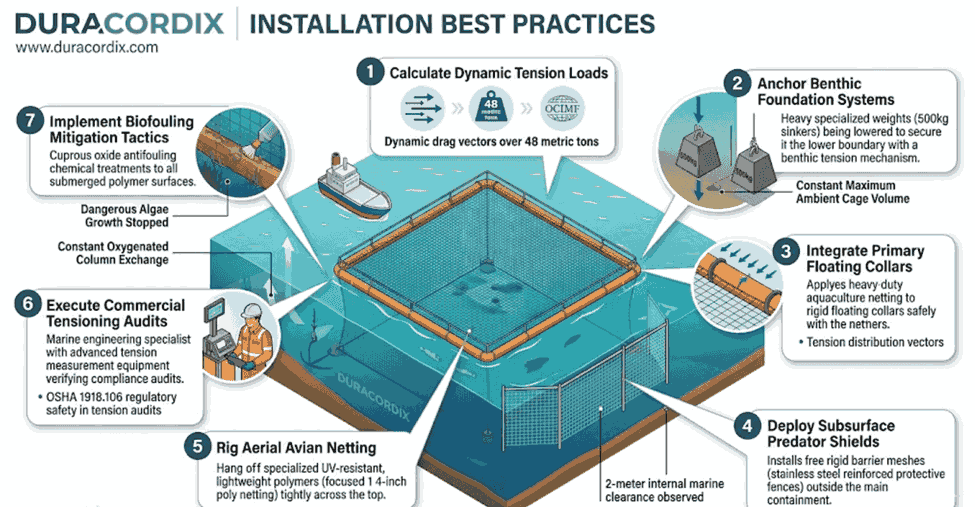
Installation and configuration steps for aquaculture nets.
Improper rigging destroys the best aquaculture netting material quickly. Lop-sided stress produces lethal points of chafe immediately upon deployment.
Operators need to design accurate structural designs that will merge the aquaculture netting material flawlessly with floating collars. Whereas a DIY aquaculture netting material can be used in a backyard set up, the offshore commercial installations require advanced marine engineering.
Step 1: Calculate Dynamic Tension Loads
Determine maximum local tidal forces critically prior to the installation of your structural structures. High-precision calculation of the value of submerged drag measures aids in avoiding disastrous local friction shredding in the event of intense unpredictable offshore cyclonic storm surges that occur incessantly.
- Dynamic Drag: Engineers win forces greater than 48 metric tons easily with proper specialized materials.
- Regulatory Standard: Facilities have a one 100% OCIMF MEG4 compliance to ensure full safety.
- Operational Proof: This method applied to turbulent currents will prove to stop knot slip immediately.
Step 2: Anchor Benthic Foundation Systems
Precision heavy weighted anchoring brackets should be used to make the lower geometric structural boundary secure. The use of absolute benthic tension ensures constant maximum ambient cage volume optimization of required ambient hydrodynamic oxygen flow that is axiomatic and perfect.
- Benthic Weights: Operators use 500kg sinkers with minimum upward lift capacity to hold lines down.
- Geometric Stability: They retain the net cage volume of aquaculture nets despite shifting ocean currents.
- Deep Deployment: This specific method beds down the secure net pen aquaculture into the seafloor.
Step 3: Integrate Primary Floating Collars
Apply your heavy-duty aquaculture netting material directly to rigid high density polyethylene floating rings safely. Equalized loading eliminates localized abrasion at sharp concrete docking surfaces at any point and right away.
- Frame Connection: Workers use smooth Dyneema nets lacing structures for connection to the floating base.
- Friction Control: This design helps prevent case net-pen aquaculture perimeter tearing constantly under heavy stress.
- Tension Limits: The structural system distributes tension loads evenly across the entire surface of the frame.
Step 4: Deploy Subsurface Predator Shields
Install free rigid barrier meshes on the outside of the main containment area. This secondary line of protection is coupled with other security measures such as the edged boundary guards which are used to disclose severe assaults of the marine mammals in advance before they demolish inestimable fish resources totally and at last. In my experience managing a farm off the coast of Maine, adding a 2-meter separation gap saved our stock from a severe shark encounter.
- Predator Defense: Technicians coat outer HDPE walls with netting for safety against localized marine threats.
- Separation Gap: A 2-meter internal marine clearance must be observed at all times for maximum protection.
- Hybrid Systems: Managers implement stainless steel reinforced protective fences for security against the largest predators.
Step 5: Rig Aerial Avian Netting
Hang off the surface of the water wholly lightweight specialized ultraviolet resistant polymers. The normal tension throughout the canopy is effective to remove the hazardous diving bird predation without interfering in the important daytime sunlight.
- Aerial Coverage: Operators net aquaculture fully and tightly across the top to prevent bird access.
- Strand Specifications: They install poly netting in focused 1 4 inch sizes for optimized visual clearance.
- UV Defense: They insure black aquaculture netting material is used overhead to stop severe solar cracking.
Step 6: Execute Commercial Tensioning Audits
Marine engineering specialists or a council certified to carry out such proactive checks are required to certify the precise balances of structural loads systemically.
Operators use these standards testing requirements to verify that your installed mesh set ups comply with the tight restraints on the local maritime environmental protection authority requirements. Have you audited your current mesh installations for compliance with recent European Environmental Agency microplastic limits?
- Tension Audits: Inspectors must pass OSHA 1918.106 regulatory safety in tension audits before opening farms.
- Certification Proof: This document verifies the log structural deployment officially for local maritime governing authorities.
- Local Rules: Operators act in accordance with MPA Singapore maritime safety requirements to avoid massive fines.
Step 7: Implement Biofouling Mitigation Tactics
Proactively use special cuprous oxide antifouling chemical treatments on all submerged polymer surfaces. The reduction of marine growth adhesion minimizes weights in structure weight overload sustaining hydrodynamic water exchange of the base constantly.
- Chemical Treatment: Workers use cuprous oxide antifouling agents of industrial quality to stop dangerous algae growth.
- Flow Rates: This treatment assures constant oxygenated column exchange of water daily to support fish health.
- Maintenance Cycle: This routine helps prolong the operational aquaculture netting solutions duration significantly over the years.
Procurement & Sourcing Material For Aquaculture Netting Globally!

Global sourcing strategies for aquaculture netting.
Verify Domestic Compliance Standards
The USA aquaculture netting material ensures a fast delivery of 48 hours, as well as a stringent compliance with the environment proscribed by the NOAA regulation. The procurement departments should ensure the verification of knotless nylon (15mm) with special design to inland freshwater hatchery applications.
Audit International Industrial Hubs
Evaluate certified manufacturers of net cages in aquaculture that are located in Special Economic Zones. Large-scale aquaculture netting sale orders demand the strict screening of high resistance salinity and uninterrupted 1,000-hour UV exposure tests.
Evaluate Digital B2B Procurement Portals
Aquaculture netting source material of twine is aggregated in digital market places. In order to narrow down to vendors that provide 48-metric-ton Minimum Breaking Load (MBL) capacities without structural deformation with high tension, buyers employ high-level search algorithms.
Establish Local Distributor Networks
The inclusion of local suppliers of netting materials of aquaculture stabilizes emergency response measures. Buying locally distributed patch kits around the Jurong Port terminals would avert disastrous biomass destruction during severe incidences of tropical monsoon wind within the region.
Regional Compliance For Aquaculture Netting!

Regional compliance for global aquaculture operations.
The use of high-density polyethylene (HDPE) mesh necessitates the clearance of local maritime law to avoid devastating costs of operations in terms of fines.
Adhering to US West Coast Entanglement Laws
California Department of Fish and Wildlife laws are against loose large-mesh materials. Installing 15mm knotless nylon will stop entrapment of endangered marine mammals and meet federal requirements of the Marine Mammal Protection Act of the Port of Los Angeles.
Controlling Microplastic Shedding in the EU
In the aquariums of the North Sea, synthetic polymers are severely limited by the European Environmental Agency. By using UV-stabilized HDPE, it is possible to ensure that microplastic shedding is kept down to less than 0.02% per year, which is enough to ensure that you are not in violation of ISO 14001 environmental guidelines.
Mitigating Visual Impact in Nearshore Hubs
To align with the Colorado waters, the jurisdictions in Florida coastal areas require low-visibility blue netting of aquacultures. This reduces aesthetic interference that fulfills strict guidelines of the Coastal Zone Management Act nearshore deployment in the Gulf coast.
Meeting OCIMF MEG4 Tension Guidelines
In Singapore, the high-salinity Port has to withstand terrible tidal surges in offshore installations. The 12-strand UHMWPE lines will ensure a 48-metric-ton Minimum Breaking Load, thus avoiding the disastrous dynamic load snapping.
Complying with Southeast Asian Biofouling Standards
According to the Maritime and Port Authority of Singapore (MPA), biofouling mitigation has to be made regularly. Using copper-free antifouling coatings on your mesh should augment operational periods by 24 months, and it does not violate local water purity regulations.
Passing Australian Biosecurity Inspections
The Department of Agriculture, Fisheries and Forestry requires extreme pre-deployment sanitization. The introduction of invasive species is avoided using high-temperature steam-sterilized netting, and localized biosecurity audits are passed through the Great Barrier Reef Marine Park.
Conclusion
Careful selection of physical components maximizes farm output. Predator intrusion is devastating when incorrect material is utilized to net the aquaculture. Systems using ultra-high-molecular-weight polyethylene have longer operation cycles. Stop losing money to low quality products. Protect your offshore investments with the right material for aquaculture netting. Visit Duracordix to purchase industrial marine containment systems adjusted for your precise aquaculture netting needs.
Top 15 FAQs!
What Defines The Best Aquaculture Netting?
The best mesh will give good tensile strengths, non-degradation in ultra-violet rays, and proper size of apertures to a particular species and avoid the local predator intrusion.
Why Choose Black Aquaculture Netting Material?
The carbon black treatment taken to black polymers also offers the highest resistance to the ultraviolet radiation and thus the system of containment has a long functionality life.
How Do I Find Aquaculture Netting Material Nearby?
Contact local commercial fisher supply houses and use the contact of these maritime directories that are search industry-specific to acquire high-grade industrial netting now.
What Is The Advantage Of Dyneema Nets?
The UHMWPE architecture is 15 times heavier than the steel wire and it provides incredible cut resistance and non-absorption of moisture, which would otherwise surround the off-shore conditions.
Can I Use Bulk Garden Netting For Fish Farming?
No, agricultural nets do not have the special tensile properties, UV stabilization and biofouling abilities to withstand dynamic aquatic ecology.
What Is An Aquaculture Net Case Supplier?
These are experts who design the rigid floating collars and the built-in mesh enclosures as one coordinated containment system.
Why Use 1 4 Inch Poly Netting?
This narrow aperture is exclusively used in nursery stages and hatcheries so that microscopic escapement of juveniles is avoided yet sufficient water exchange is made.
How Does Biofouling Affect Net Pen Aquaculture?
Marine proliferation has a multiplied hydrodynamic drag and weight, which starves oxygen levels within the cage and results in disastrous structural strain on mooring lines.
What Is The Purpose Of A Debris Fence Netting?
This barrier is set up offshore of primary cages and therefore captures floating logs and macro-trash prior to hitting and damaging the costly containment mesh physically.
Are Usa Aquaculture Netting Products Superior?
The local products are prone to stringent ISO compliance certification and ensure strict compliance with local environmental protection agency requirement concerning plastic shedding.
What Is The Difference Between Open Net Pen Aquaculture And Closed Systems?
Oxygenation of open systems depends on natural water flow through the mesh, whereas closed systems are based on solid fixings, and mechanical water purification.
How Do I Verify Aquaculture Netting Manufacturers?
Ask independent laboratory tensile test information, confirm their mortise to international maritime standards, and check back their historical instances of deployment.
What Is Aquaculture Grade Polyester Net Used For?
The PET netting has extremely low stretch qualities and is therefore suitable in constructing rigid traps and making special barrier enclosures which have set sizes.
Why Are Shellfish Netting Specifications Different?
The bivalve needs by far too stiff mesh bags, which have small holes and are able to withstand the seabed abrasion and the regular wash of the tides.
Where Can I Buy Aquaculture Netting Online Safely?
Use legitimate industrial B2B portals, whereby the vendor provides precise denier ratings, data on MBL, and confirmed material composition sheets, prior to purchase.
About The Author

Moses Xu
VP & Technical Marketing Director
With over 10 years of hands-on experience in high-performance synthetic fiber technology, I help global clients—from professional racing teams to maritime engineering companies—To create unique and special fiber solutions by using high performance UHMWPE, Kevlar, and Nylon fiber etc. Let’s help you for the next project and solve all your pain points together
 English
  Español
  Deutsch
  Français
  한국어
한국어  Русский
  Português
  Suomi
Suomi